
It is very common for people to consider the robe à la polonaise to be a gown made in the same way as the robe à l’anglaise, but with the skirt pulled up through rings arranged on either side of the center back. This can be seen in costuming websites and respected museums alike. However, a closer look at period fashion plates hows that this is not exactly the case.
[Edit, 1/14/2013: Newcomers, you may want to see my tag for the polonaise, which will show you all of the Galerie des Modes polonaise plates I’ve translated so far. There are more plates than I give below, plus they have longer descriptions that I’ve also translated. I very definitely stand by my “no waist seam” pronouncement at this time.]
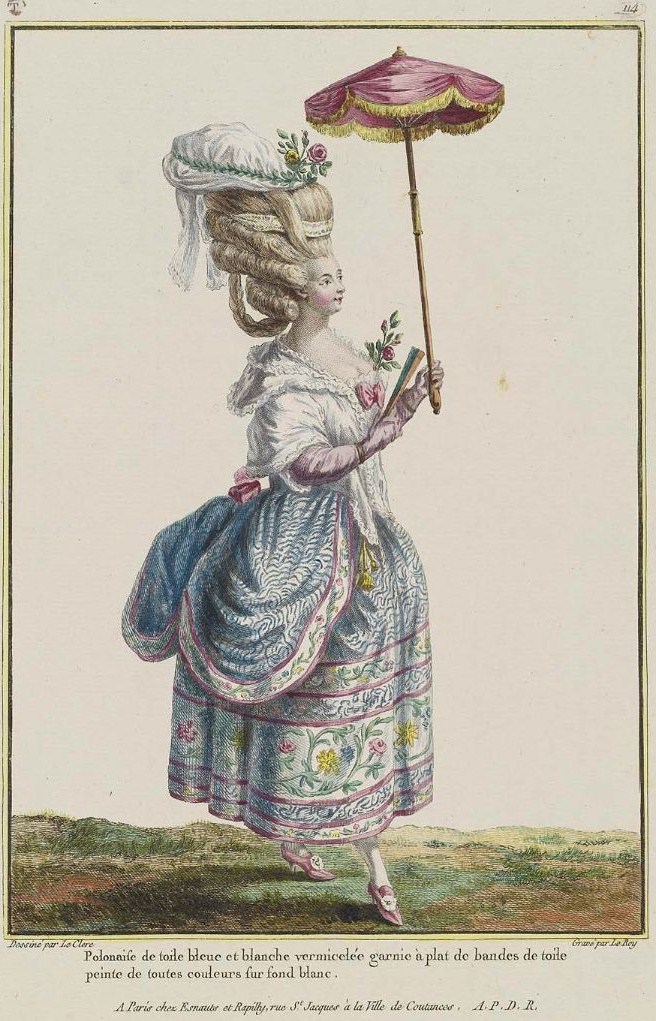
Polonaise de toile bleue et blanche vermicelée garnie à plat de bandes de toile peinte de toutes couleurs sur fond blanc.
Polonaise of vermicelée blue and white linen, trimmed with flat bands of multicolored painted linen on a white ground.
The dress shown in this fashion plate, labeled “Polonaiʃe de toile bleue et blanche vermicelée …” has much more of the skirt pulled up than the extant gown linked above. The skirt of the extant gown is clearly a normal, full-length skirt that has been drawn up into folds, but the skirt in the fashion plate appears to have been specially-cut in order to be able to form the three rounded “petals”. It’s possible that this could be artistic license, but we also have this dress: MMA 1982.32.
It’s difficult to tell from a photograph, but the skirt of this polonaise seems to have been treated differently than that of the rucked-up anglaise. The hem may have been cut partially into the petal shapes, or perhaps the difference is in the way it has been pulled up. There is also a difference in the bodice: the anglaise uses several shaped pieces to form the back, but the polonaise uses three back seams, as in a man’s coat. It also does not have a waist seam. The existence of polonaise caracos without drawn-up skirts seems to indicate that the cut of the back was just as important as the skirts.
(A large selection of polonaises can be found in my Pinterest account.)
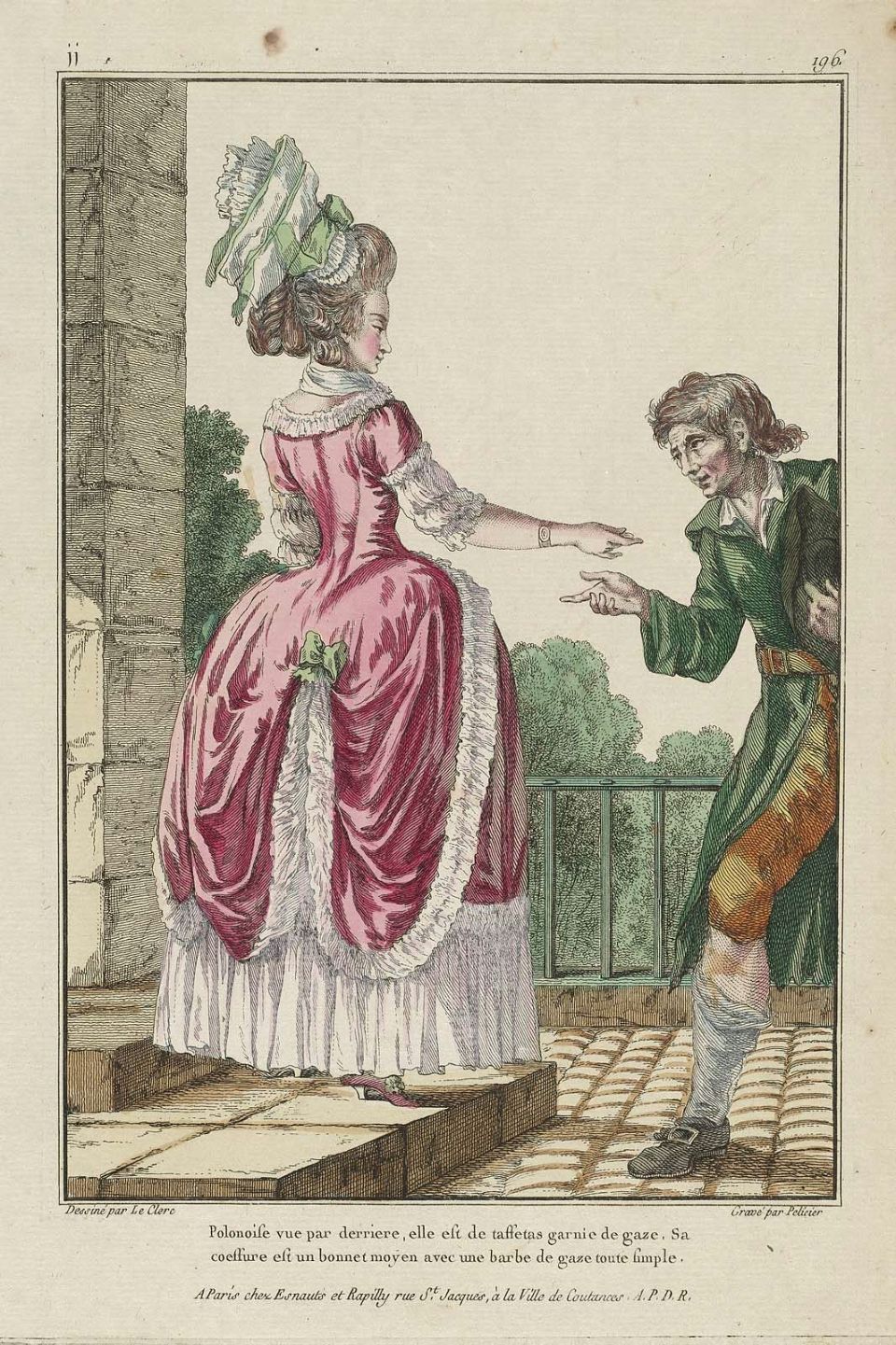
coeffure est un bonnet moyen avec une barbe de gaze toute simple.

 Mimic of Modes