
To continue from my last post …
The Mid 1770s (1774 – 1776)

The
woman is wearing a striped jacket and petticoat; the jacket’s sleeves
have turned-up cuffs and are below the elbow, and her apron is as long
as the petticoat. Her kerchief is worn over the jacket, and her cap is
tightly fitted to her head, with a double ruffle around it.

This
servant woman is wearing a long European-style bibbed apron, which
hides her bodice. Her gown is pulled up over a flounced petticoat. The
stripes on her sleeves run horizontally, and her sleeves cup her
elbows, with ruched cuffs and bows. She wears a ribbon choker.
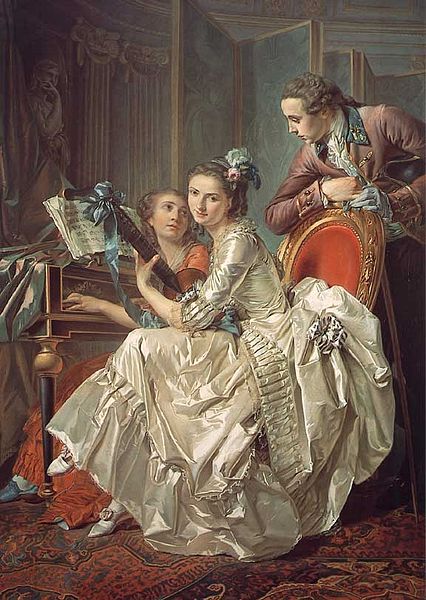
The young woman in the foreground is also wearing a polonaise
with a bow sewn to the place where the skirt has been pulled up. Her
elbow-length sleeves have box-pleated trim as a cuff, with a bow sewn to
the inside of the elbow over the trim.
The box-pleated trim is along the edge of the skirt, and up the front
of the bodice as well. There is a delicate fly fringe around the hem of
the flounce on the petticoat, and a transparent, short flounce around
the outside of the gown’s skirt, the bottom of the sleeves, and around
the neckline.

The
mother, on the left, is wearing a sacque with a gathered or pleated
trim that meanders down the robings and the front of the skirt of her
gown, across the stomacher in rows, around the bottom of the petticoat,
and above the ruffles on the sleeve. There is a large bow on the top of
her stomacher, and her kerchief is small enough to cross at the base of
her throat and reveal her chest. Her daughter, on the other hand, is
much more modern: the trim on her sleeves is ruched, and her bodice
meets at the top of the stomacher and runs down to the side of her
waist. Her gown is probably a polonaise, trimmed all the way around, with a bow sewn to the place where the skirt is rétroussée.

Both of these ladies are wearing rétroussée gowns; the one on the left is an anglaise
and the one on the right is a sacque. (Or a piémontaise – the fashion plate of which, you will note, is from 1778 but depicting a dress of 1775.) Both also wear ribbon chokers
and have a row of meandering gathered trim at the bottom of their
petticoats: the lady in the sacque, however, has more trim creating a
diamond pattern on the front of her petticoat and between two rows of
gathered trim down the front of her skirts. She also has trim on the
lower part of her robings and on her flared cuffs. The lady in the anglaise
has three rows of trim on her sleeves and a very small self-fabric
ruffle on the end. She may also have a small pin holding the back of
her kerchief to her gown.
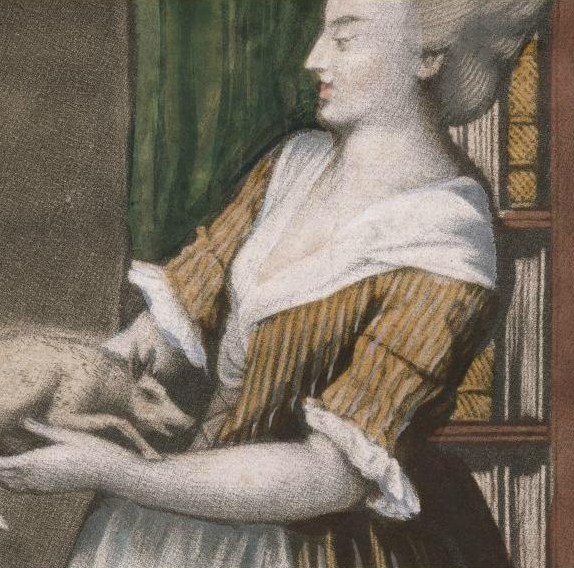
This
serving woman’s bodice does not have a stomacher, but does not actually
close center front: it laces over her stays, with her kerchief tucked
into the lacing and under the fronts. Her sleeves are shorter than
those in the portraits of fashionable women, but are trimmed with
box-pleated dress fabric.

This
fashionable woman is wearing a gown with narrow, gathered trim on the
robings and down and across the stomacher in a T-shape, with slightly
broader, ruched trim down the front of the skirts and across the front
of her petticoat. There is a bow on each of her (flounced) sleeves, and
at the top of her stomacher.

Madame is dressed en déshabille, in a peignoir
and a whiteworked muslin apron over a pink silk petticoat. The
peignoir is attached to some sort of sleeveless underbodice with a compère front.
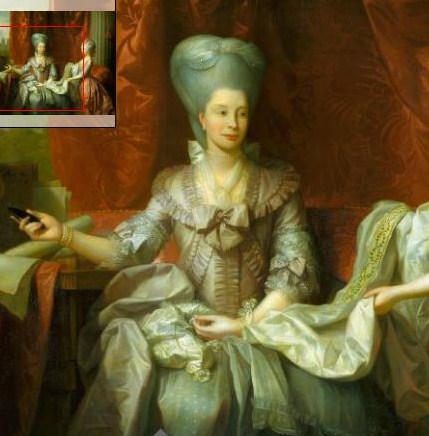
Queen
Charlotte is wearing a gown which closes at the neckline at center
front with a large bow, and falls away to the hips. There is a kind of
flat, broad collar around the neckline of the gown. The stomacher is
trimmed down the front with a gathered strip, and the collar, neckline,
and bodice fronts are trimmed with a flounce. Her sleeves have curved
gauze cuffs, with bows on the inside of the elbow. She is also wearing a
long muslin apron, a strand of pearls, and a small kerchief, gathered
with a ring or pin.
During the middle of the
decade, everything began to shift. Nearly all the styles appear in
conjunction with each other – triangular stomachers, diamond-shaped
stomachers, compère stomachers (I believe that this is the earliest soldily-dated picture I’ve seen with a compère front).
Not only was the older style still worn in general, it was still
considered fashionable – although it might be that this was a
class-related issue. The triangular stomacher-front appears in prints,
which were created by middle or working class artists, while the polonaise-style front appears in portraits, on people who were certainly wearing them when they were painted. There are textual mentions of the polonaise from 1774, but even in 1781 the polonaise had a strong class association.

 Mimic of Modes
Oh, how I just love the polonaise… Now I wish I could make another one! 😀 Great blog, btw!
LikeLike
I was so psyched when I saw your polonaise for the first time – there aren't enough with the right cut.Thanks!
LikeLike