
Normal
0
false
false
false
EN-US
X-NONE
X-NONE
/* Style Definitions */
table.MsoNormalTable
{mso-style-name:”Table Normal”;
mso-tstyle-rowband-size:0;
mso-tstyle-colband-size:0;
mso-style-noshow:yes;
mso-style-priority:99;
mso-style-parent:””;
mso-padding-alt:0in 5.4pt 0in 5.4pt;
mso-para-margin-top:0in;
mso-para-margin-right:0in;
mso-para-margin-bottom:10.0pt;
mso-para-margin-left:0in;
line-height:115%;
mso-pagination:widow-orphan;
font-size:11.0pt;
font-family:”Calibri”,”sans-serif”;
mso-ascii-font-family:Calibri;
mso-ascii-theme-font:minor-latin;
mso-hansi-font-family:Calibri;
mso-hansi-theme-font:minor-latin;
mso-bidi-font-family:”Times New Roman”;
mso-bidi-theme-font:minor-bidi;}
buy some fabric at Mary Dickinson’s store.
Well, I didn’t know at first; I forgot until I saw the store and went,
“OH, YES, OF COURSE I MUST.” And I’ve
wanted to make a polonaise* for a while, both
because they’re cool and because I should put my money where my mouth is, or
something, and make one if I’m going to make a post every time I come across a
reference to them.
because I’m getting more into using English terms, but another part of me is
fairly sure that a) that would look weird to everyone and b) I’ve got enough
problems insisting on a stricter definition of the polonaise, do I really need
to compound it by being crazy about spelling as well?
beautiful, but the trouble is that fairly soon after ordering it I started
wondering if it were even close to being suitable for a polonaise. I know from past research that it was
considered by some to be a style of dress that only the wealthy ought to wear;
paintings of women in polonaises show
them made in silk.

plates first, because I knew that a lot of them were showing walking and
negligee dress, which might be more casual.
Fortunately, I did find a few good leads.
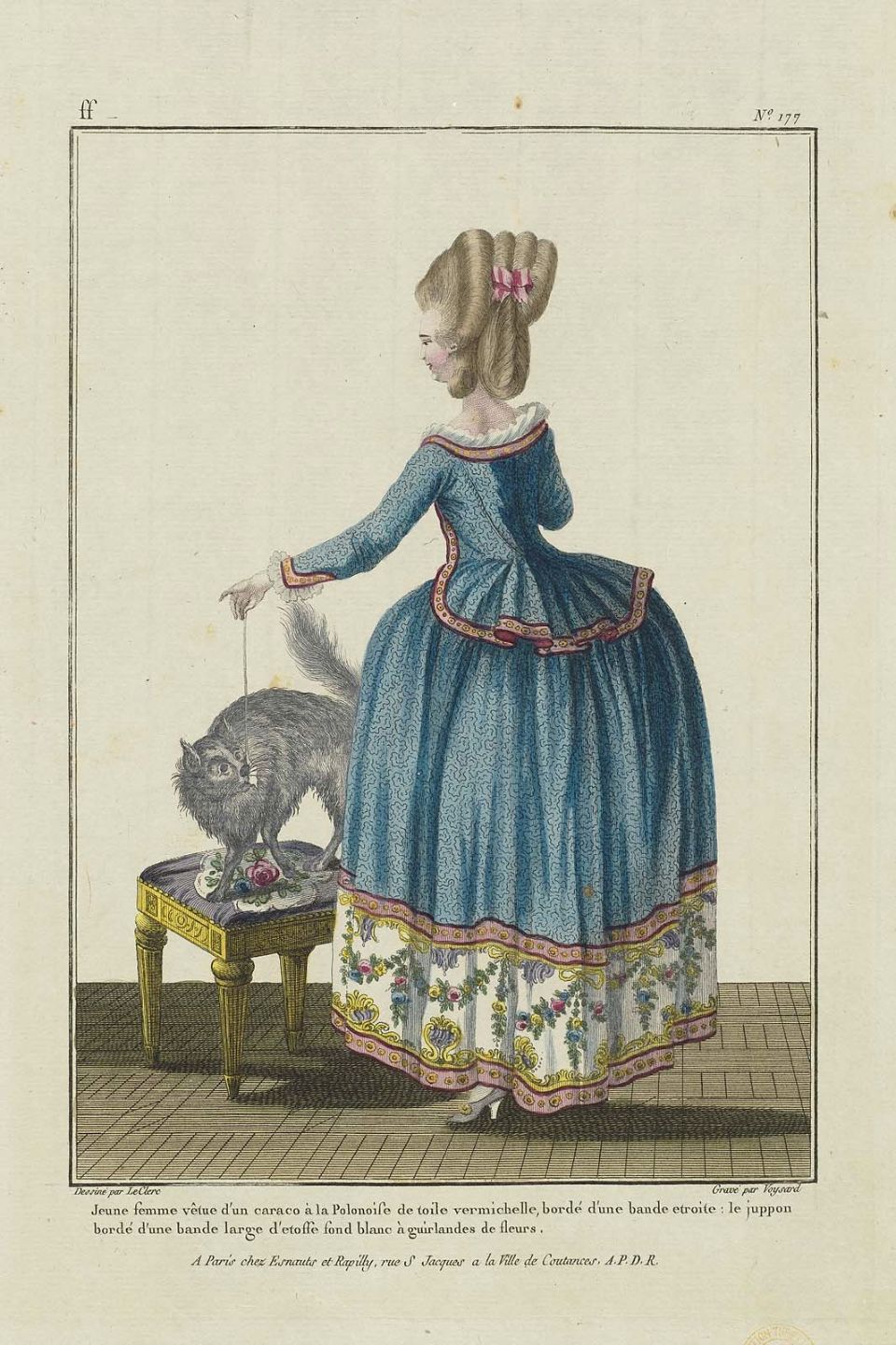
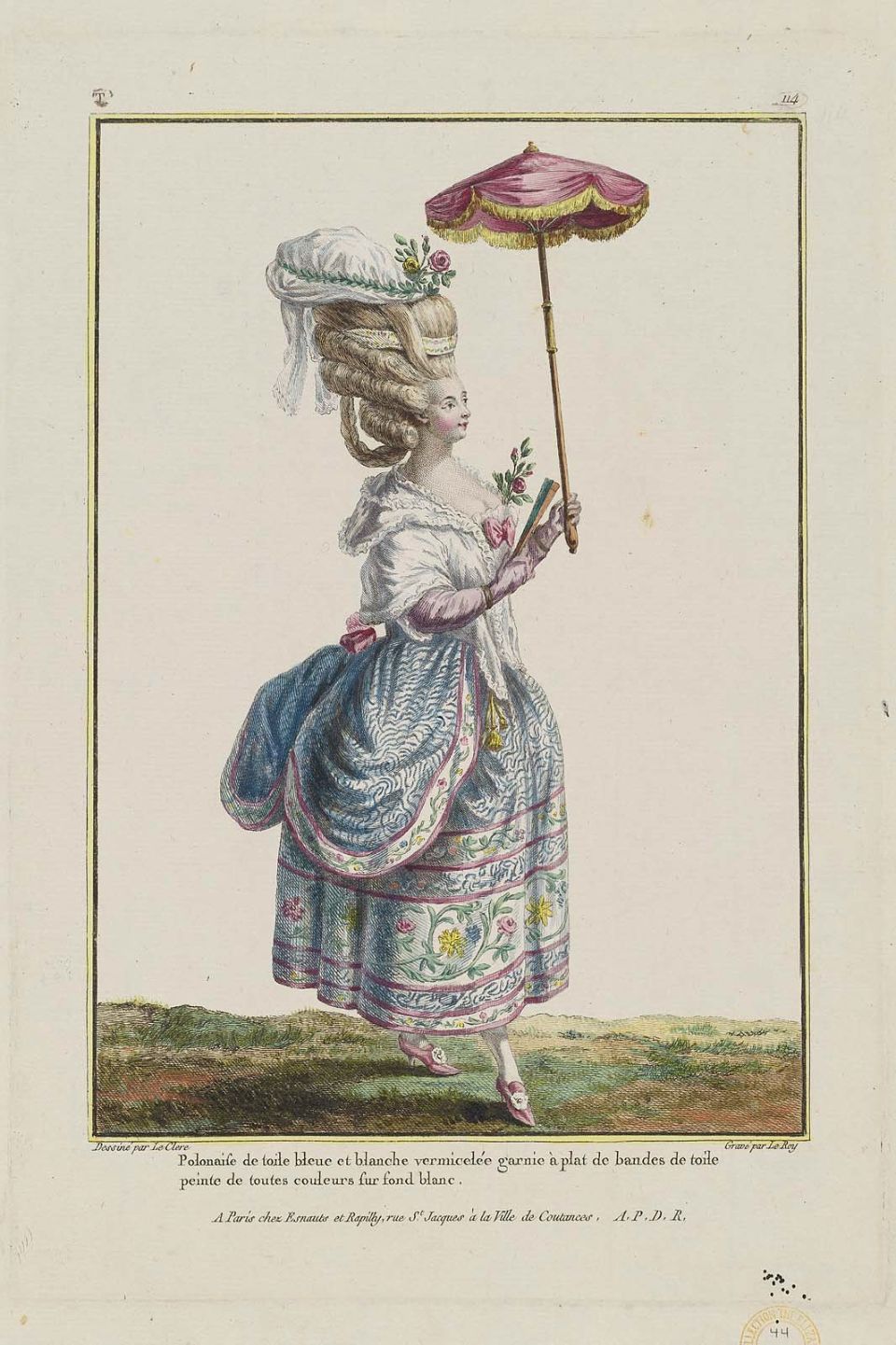
1779; MFA 44.1390
“Jeune femme vêtue d’un caraco à la Polonoise …”, Gallerie des Modes, 1780; MFA
44.1468
but it’s similar in terms of value at the time. There are also other fashion plates with polonaises in muslin, striped Indian cotton, and a floral printed cotton. So cotton and prints in general are all right.
that there aren’t very many of them, all
of them that I know of are silk, and none of them in a silk patterned anything like this cotton. (What of this example in the V&A, you say? I’m not sure it counts. The skirt looks like it’s cut like a polonaise, rounded, but the bodice is fitted with a waist seam and it’s been altered, so who knows what that skirt was like originally.) But when it comes to
cotton clothing, absence of evidence is definitely not evidence of absence, as
cotton degrades pretty easily – it also tends to be more attractive for cutting up for patchwork or rags, as it’s less shiny.
other things to do right now so this isn’t exactly a pressing quandary, but I want to be sure it’s completely right for a polonaise. I’m pretty sure it’s acceptable.
My issue is that I have a principle of not doing anything I can’t
justify to a hypothetical person who comes up to me and demands to know my
documentation for doing such-and-such.
(This is not a principle I think everyone else needs to hold to!) This isn’t because I worry that it’s going to
happen – I’m nearly certain it won’t ever – but for me, costuming is an extension of my
research. Not so much in the sense that
it’s experimental archaeology, although it can be; more in the sense that the sewing is the last part of the research, researching inspires me to sew, or to want to sew (let’s be honest). Also, I’m unnecessarily serious about everything. And if that hypothetical person ever does show up, I want to be smug and
reduce them to a stammer.

 Mimic of Modes
