

Hello! It’s been a while – due to American politics, personal issues, and other factors, I just haven’t had the energy to spend on historical sewing or writing about fashion (beyond what I do for AskHistorians; link to my profile if you’d like to read some short articles on a variety of social history topics) – but last month, I attended the 2018 CSA Mid-Atlantic/Southeastern Biregional Symposium in Shippensburg, PA. It was quite a trip! I was so happy to meet up with so many fashion history scholars, and particularly to meet Ann Wass (of Riversdale House Museum), Mackenzie Anderson Sholtz (of Fig Leaf Patterns), and Lydia Edwards (author of How to Read a Dress). You can see all of my photos of the exhibition at the Shippensburg Fashion Archives and Museum on Instagram! I delivered a paper of my own, which I hope to turn into a podcast episode/blog post soon, but what really thrilled me was the presentation Mackenzie gave, “A Transitional Corset and its Companion Gown c.1804 from the Collection of the DAR
Museum”.
Said transitional corset is available as a pattern from Fig Leaf, for illustration.
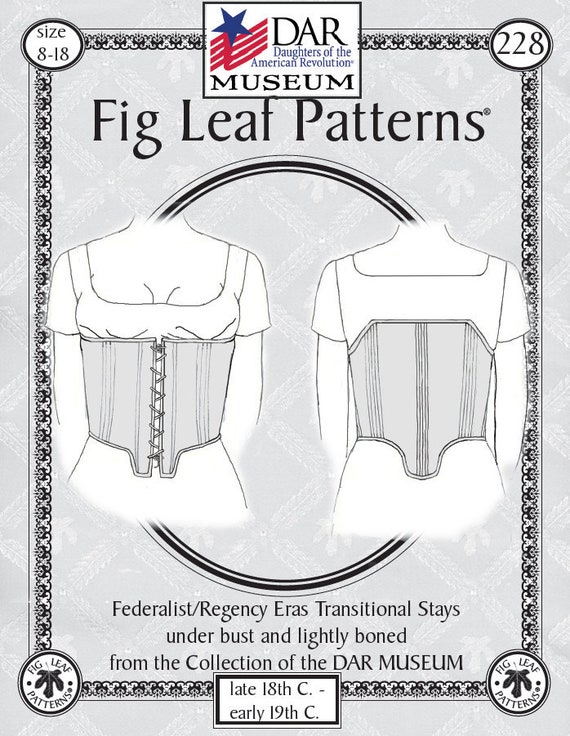
At first, I was interested because it was based on actual garments and their construction, and because Mackenzie is an authority on that kind of thing, and because you know that transitional period is kind of my Thing, but when I was watching it, I realized that I recognized these stays – although not this particular version.

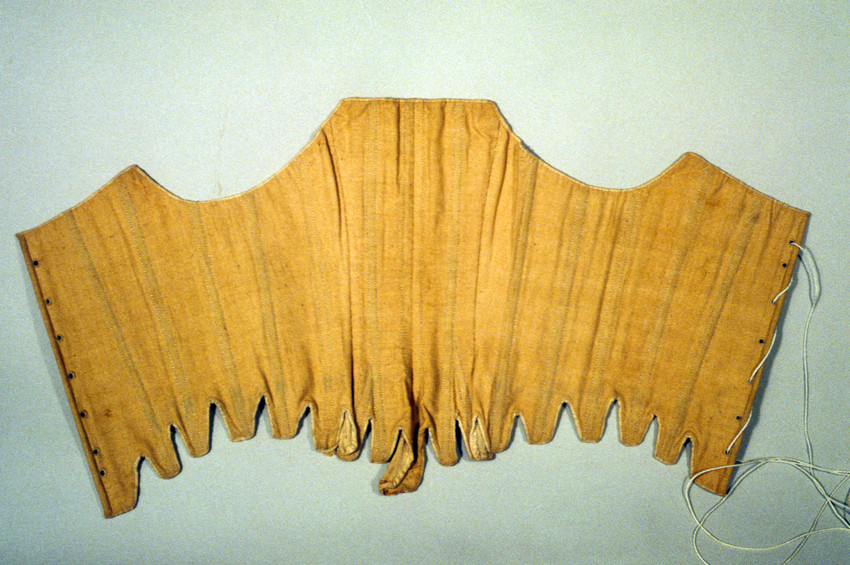
In 2011, I visited Historic Cherry Hill, a home once owned by the Van Rensselaers in Albany, NY, to do research for my qualifying paper (thesis). I came across this pair of very plain stays that have confused me ever since.
Best of all, a set of front and back lacing strapless mid-18th century stays. Sounds ordinary, yes? But they’re made from two layers of unbleached linen with no visible seam allowances. The pieces in both layers are were put together, and then the seam allowances were turned in and sandwiched between the layers; the pieces were then butted together and overcast, leaving a flat, clean seam. The front and back pieces were cut with the lacing edges on the fold. AMAZING! (They’re also not fully-boned – the channels are in groups of two to five.)
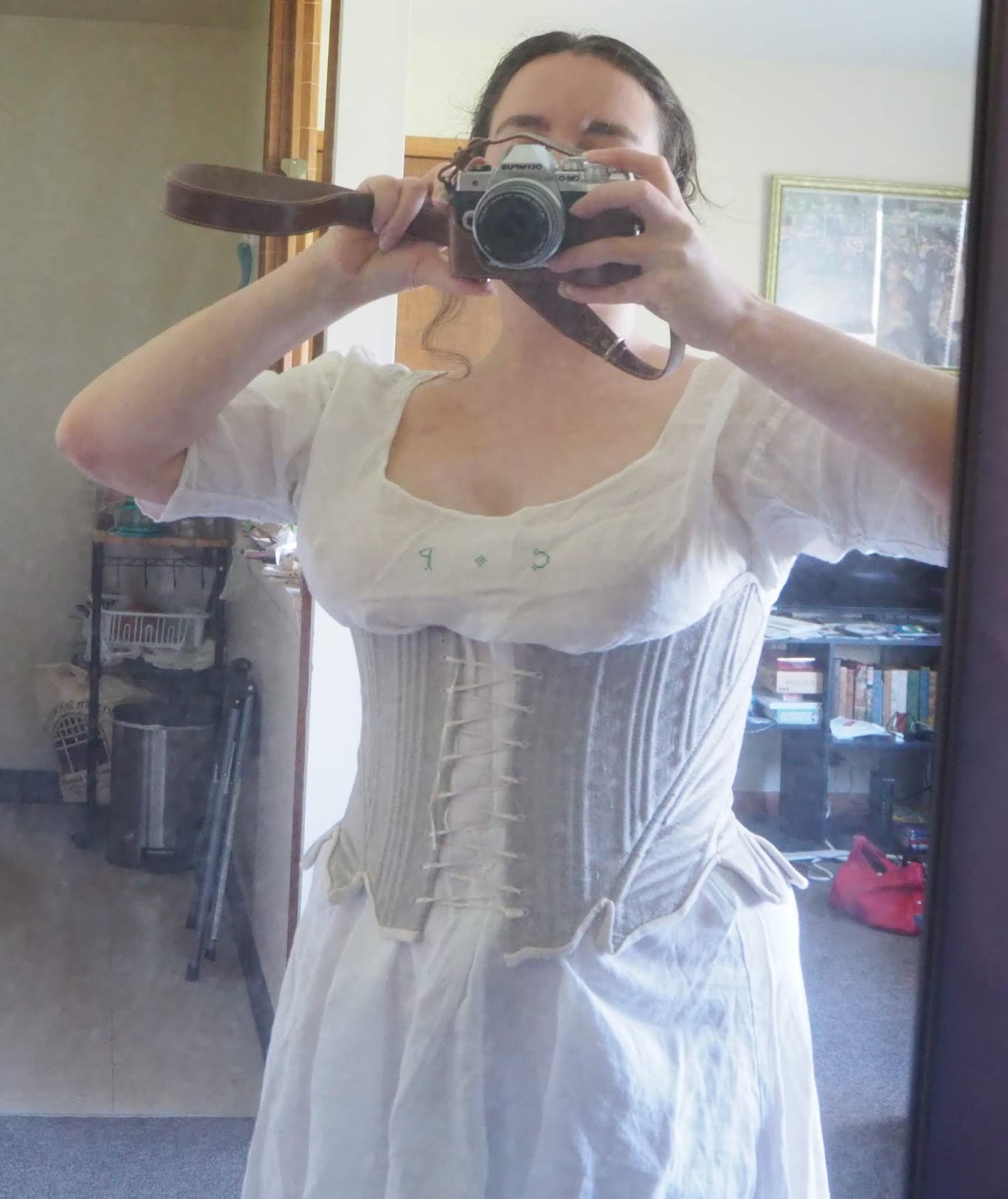
I originally cut the front too high – or the rest of it too low (but I’m short-waisted so it worked out all right for me). Not sure how it happened. But it was an easy fix! These don’t have a lot of boning, unlike the stays most people make, but these are a reproduction of a pair at Cherry Hill, so I’m pretty sure it’s period. The curved channels ought to straighten out and overlap with the addition of boning, but I might need to take out the stitching and make the curve more gradual.
My stays are comfortable enough, but they don’t have enough of a lacing gap and I seem to have some kind of mental block when it comes to bust:waist proportions (I really ought to be getting a more hourglassy figure).
 |
| You can see that I tried to make the front disproportionately high at one point before deciding that was too far from the original |
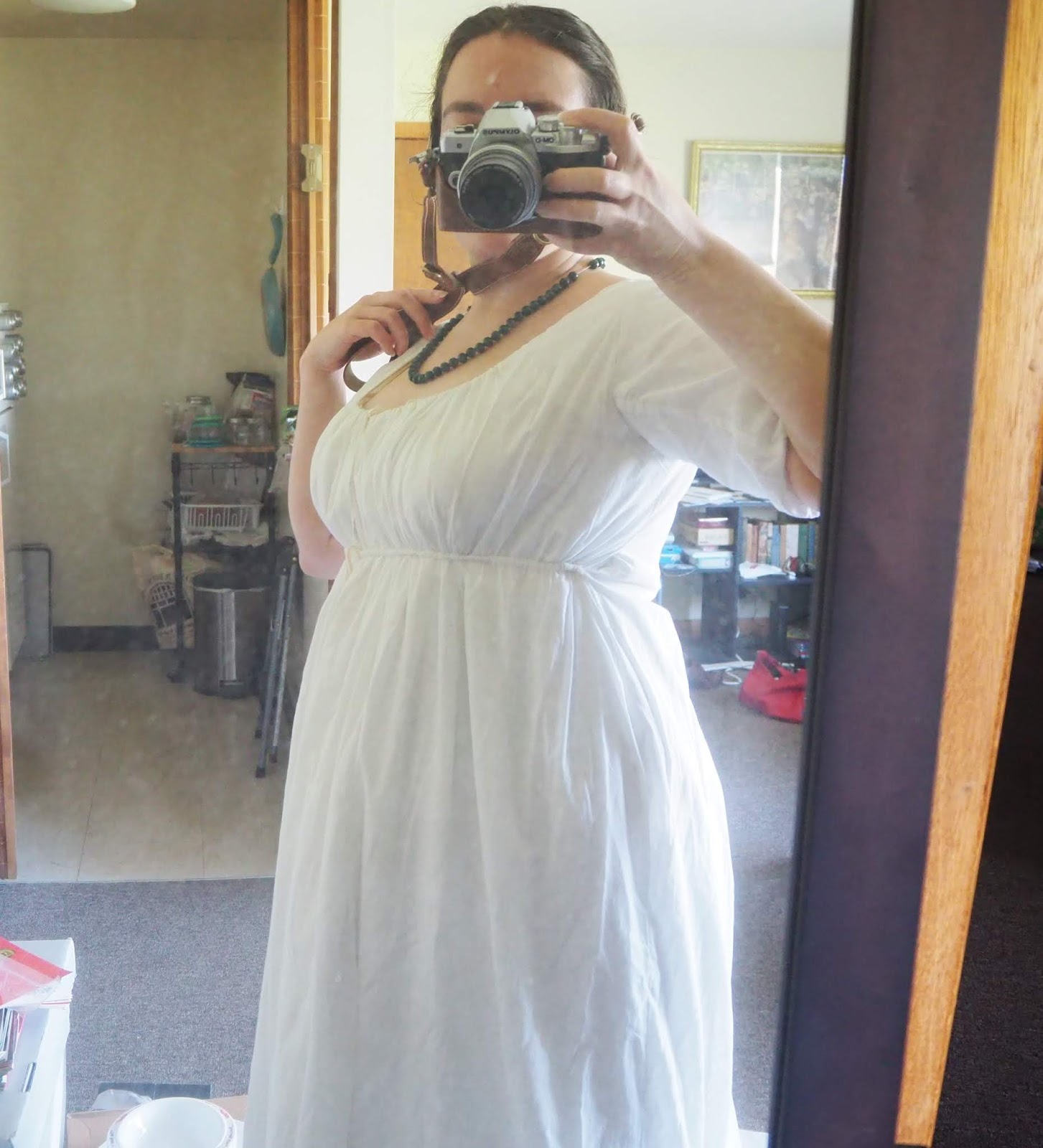
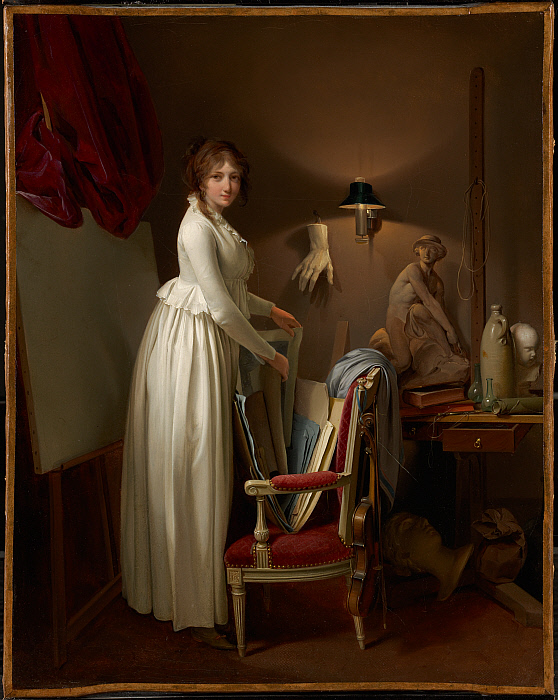 |
| “The Artist’s Wife”, Louis Leopold Boilly, 1795-99; Clark Art Institute 1955.646 |
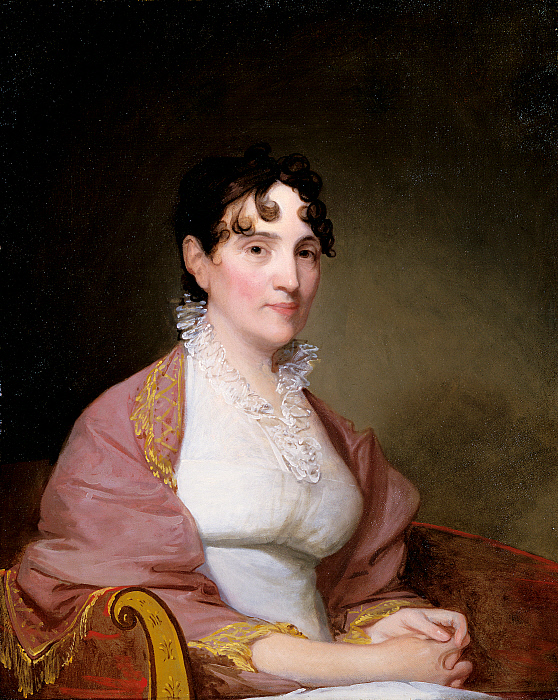 |
| “Mrs. Martha Hubbard Babcock”, Gilbert Stuart, ca. 1806; Clark Art Institute 1994.14 |
Because this was something of a make-do, there seems to be more variation in construction than there is with earlier stays and later corsets. There’s a lot more to learn about it!

 Mimic of Modes
Fascinating! For comparison, do you think the 1795-1805 short stays in your book (with their slightly higher front, and diagonal boning) supported the bust fully, or that they were an in-between semi-supportive style?
LikeLike
That is SO interesting! I think that second portrait really shows what you're talking about. There's a pretty hard line under the bust that seems to be squeezing up the bust, which is supported by other layers. Thanks for sharing all this info! I love it!
LikeLike
Definitely! When I look at 1800s portraits now (vs. 1810s or 1820s), I'm noticing the different profile in a lot of places. Pretty cool, and it's giving me way too much inspiration!
LikeLike
Maybe in-between! The front seems too high to be underbust but too low to be really supportive.On the other hand, I was peering at the illustration that goes along with those stays, and it seems to depict a woman wearing underbust stays. You can distinctly see her entire bosom above the top edge. So at least now there's visual evidence!
LikeLike
I am not seeing any of these as necessarily underbust. On someone with a torso as short as mine, they'd fit as ordinary bust supporting stays. I would like to see good evidence that underbust stays were a thing, like say a Rowlandson cartoon, before I'd believe this hypothesis is even a possibility.
LikeLike