
Twelve flat alaises [a type of bedsheets].
Twelve pleated alaises.
Six stomach bands.
Two muslin déshabillés.
Seventy-two chauffoirs [probably post-birth sanitary napkins].
* Six amadis camisoles, with or without hood.
* A large foot-cover for the bed.
* A smaller one for the chaise longue.
Head.
Forty-eight béguins.
Two cauls.
Twenty-four wraps for wool caps, in three lengths.
Twenty-four cornet caps for night, for three ages.
Twenty-four round caps, for three ages, in muslin or lace.
Twenty-four collar handkerchiefs in batiste, trimmed with muslin.
Six collar napkins trimmed with muslin.
* Six wool caps.
Seventy-two diapers.
Twelve suit or sleep bands.
Eighteen fustian blankets.
Six plain napkins to place at night around the wool blankets.
Two quilted blankets of muslin.
Two blanket edge-covers, for the quilted muslin blankets.
A good blanket edge-cover, for the quilted white satin blanket below.
Twenty-four brassiere shirts, for three ages.
Twelve bibs for two ages, trimmed or in muslin or lace.
Thirty-six handkerchiefs for wiping the infant.
* Six blankets of cloth-of-Dreux; (coarse white wool cloth made for straining ratafia).
* Four blankets of espagnolette [a type of shalloon, a twill-woven worsted wool].
* A quilted blanket in white satin.
* Six brassiere shirts of espagnolette.
Two full outfits, consisting of:
* A bassinet.
* An over-bassinet of stuff.
An in-bassinet, also called over-bow, of fabric.
* A mattress.
* Two bassinet pads
Six pairs of bassinet cloths.
* Two wool covers.
* Two feather pillows; namely, a square one for the bassinet, and a long one that the nurse puts on her knees when she dresses the infant.
Twelve pillowcases; namely, six for the square pillow, and six for the long pillow.
The term “suit” means the pieces of the layette which were given in the list, and the way they are put on the infant until the age of three years, when girls are put into a shift and jacquette, and the boys into a fourreau until four or five years, when they are given their first breeches. Girls remain in the jacquette until five years old.
The diaper (three years old)
The wool cap with its brim-cover (three years old)
The round cap for day (three years old; for girls, six months for boys, who then wear a toquet)
The cornet cap for night (three years old)
The têtiere cap (five days old)
The couche (three years old)
The quilted or fustian blanket (three years old)
The cloth-of-Dreux blanket (called the entre-deux blanket) with its fabric wrap trimmed with muslin (three years old)
The suit band (six months old)
A second suit band (six months old)
The espagnolette overblanket (three years old)
Quilted satin blanket, for day (six months old)
Blanket wrap, or tavaïolle, for day (six months old)
Wool cover, for night (six months old)
Collar napkins trimmed with muslin, for night (three years old)
Brassiere shirt (six months old)
Wool brassiere shirt (six months old)
Neck handkerchiefs in batiste (three years old for boys; girls always wear them)
Parure sleeves, or “little arms” (six months old)
Bib (two years old)
The jacquette.
The shirt of the first age (two years old)
The first stockings (three years old)
Pudding cap (three years old)
Stockings of the second age (three years old)
The têtiere is intended to hold the head of the infant firm and straight in its time of weakness from the day of birth, until it has acquired enough strength to hold its head straight, which is after fifteen days. To this end, after putting on the têtiere, the ends of the lappets are fastened with two pins at each side of the shoulders, one in front and one behind.
The nurse carries little handkerchiefs which she uses to blow the infant’s nose until it is six months old, when it is put into a shift and jacquette, but only during the day. At night it is put back into the suit, and that continues until it is three years old, when it is completely free of the suit. At the end of six months, one attaches other handkerchiefs to the jacquette that are a quarter-ell long and a third-ell wide, fringed and with drawstrings, that it can use to blow its own nose.
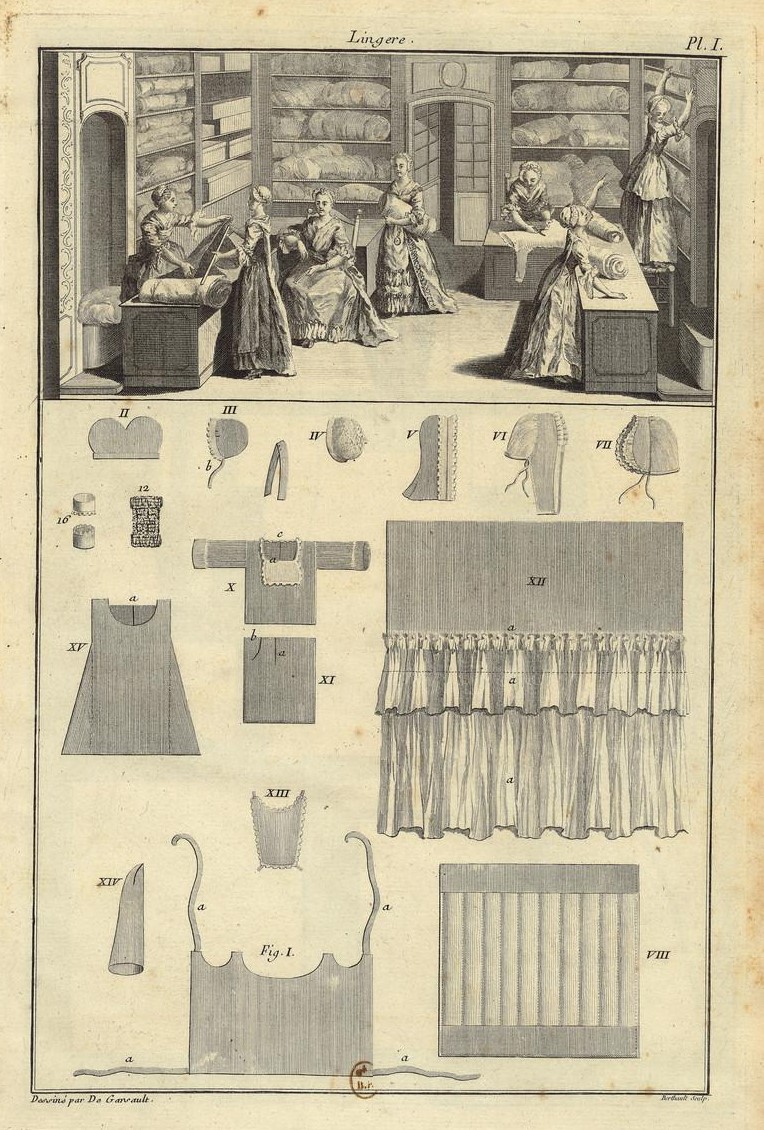
A Courtray linen, three-quarters of an ell wide, is used; four and a half ells are required for six linens. Long bands are made in a cutout three-sixteenths of an ell wide. That done, fold the cloth into sixths on the width, and cut it to shape as in Figure I, Plate 1, all six together. Sew one of four bands (aaaa) at each end in the direction shown in the same Figure.
These are made of a batiste, two-thirds of an ell wide. They are cut at right angles, two from each width: these are sewn shut on three sides, leaving the fourth open so cotton can be put in, after which it is basted shut. (See the section on pillows.)
A fabric three-quarters of an ell wide is used, with an ell and a quarter required for one body, which is folded in half on the length. A pair of amadis sleeves are taken from the width, and a quarter ell for all of the furnitures which will be added, like a man’s shirt, see after. In all, three and five-eighths ells are needed for two full shifts.
Amadis sleeves for a woman are made of Courtray linen, three-quarters of an ell wide and a third of an ell long per pair. They are cut as shown in Plate 3, Figure CCb, where they are shown inside the pattern for a man’s. Those for women are shorter and less full; the cutout one makes in cutting these serves to line inside from the cuffs to about six inches deep: this lining is sewn to the sleeve with whipstitch.
Ell-wide fabric is used. Each one takes three ells, which makes a squared piece. The edges are hemmed. These are used to decorate the lying-in bed.
Cretonne three-quarters of an ell wide is used. Two pieces are required, each an ell and a quarter in height. These are sewn together and mounted by gathering to a belt a twelfth of an ell high and three-quarters of an ell wide. These alaises are left open in front, and ribbons are sewn to it at intervals.
Cretonne of seven-eighths of an ell wide is used. Two bands are made from one ell-length, with the selvage at the bottom. The stomach bands are long rectangles, with several pleats at the top.
The déshabille consists of a bedgown, hood, petticoat, amadis, and ruffles. Only the amadis sleeves and ruffles described above are made by the lingère; the rest is the area of the seamstress.
These are made of royale, three-quarters of an ell long. Nine ells are required for a dozen chauffoirs. The manner in which they are used will be explained at the end under the heading of reference.
As the béguin cap is the first headdress of the infant, and it is not gotten rid of until it is three years old, they must be made very full, since the head grows. The proportions are given here for four ages.
Five can be made from the width, and ten from a length nine-sixteenths of an ell. Each is trimmed with a band of muslin nine-sixteenths of an ell long and an inch wide. All ten are cut together, one after the other: to do this, the width is folded in five and the length in four; a circle is cut which must be the height of the back of the head, so that the selvage is always found on the front of the béguin. See Figure II, Plate 1 where the béguin is unfolded to show the double shaping cut at the top of the head.
Four can be made from the width, and twelve in a length of thirty-one-thirty-seconds of an ell; there is still a cut-out which can make little brim-covers for the wool caps, later: the bands will be five-eighths long, and still an inch wide.
Four can be made from the width; twelve can be made from a length of one and a thirty-second ell; there is still a little cutout for the bars: the bands are two-thirds of an ell long, and an inch wide.
Four can only just be made from the width, and twelve in a one and one-eighth ell length: the bands are three-quarters of an ell long, and an inch wide like the previous ones.
Batiste is used; three-eighths of an ell long for the first age, seven-sixteenths for the second, two-thirds for the third; the whole on a twelfth in height. These are used to border the fronts of wool caps, so that the wool doesn’t rub against the face, and they are trimmed with a plain lace. Figure IV.
The fabric for the têtieres is taken from a piece of three-sixteenths of an ell or thereabouts, which was taken from the blanket edge-cover (later). Figure V shows the cut.
A fabric matching that of the béguins earlier is used, a muslin that is three-quarters of an ell wide. Four crowns can be made from the width: the crowns are three-sixteenths of an ell high and wide. Three lappets or one and a half cornettes can be made from the same width. The cornette must be three inches wide at the top of the head; said top and the two lappets, which only make one cap, are a half-ell long. In all one ell and five-sixths are needed for twelve cornettes, Figure VI.
In a linen or double muslin just about fifteen-sixteenths of an ell wide, a length of five-sixths of an ell is cut for twelve caps. Four crowns are made from the width, in the same proportion of those of the cornette above; and for the crowns and brims of said twelve caps, a length of an ell and a twelfth. The brims will be two and a quarter inches wide, and five-eighths of an ell long. A band and a half are made in the same width of a clear muslin: the under-bands will be three inches wide and five-sixths of an ell long; the over-bands are two inches wide and a foot and a half-inch long.
These are made of royale or half-holland, or else of batiste.
Royale three-quarters of an ell wide is used. Each napkin will be an ell long. They are trimmed in muslin that is three-quarters of an ell wide; the trim is a sixth of an ell wide and two and a quarter ells long. The whole bottom is trimmed: the two bottom corners and the sides are pleated to within a quarter ell of the top.
A fabric that is three-quarters of an ell wide is required; each diaper is three-quarters of an ell long, and in a perfect square. Nine ells are required for twelve diapers.
Cretonne is required. They are three ells long and an eighth of an ell wide; they are made to go around the suit several times to hold it. It would be better not to use these.
A muslin fifteen-sixteenths of an ell wide and an ell long is required for each. It is lined with a good garas of the same width, or with a coarse muslin: cotton is put between the two, and it is quilted. (See Figure VIII for the shape.)
These are not quilted. Take an ell and a half of fustian a half-ell wide; cut it in two down the length. Put each piece one on the other, keeping the nap on the outside; leave a sixteenth ell unlined on each side of the blanket, to allow for attaching the pins.
A Laval linen or a half-holland three-quarters of an ell wide is required; each napkin is an ell long. These napkins are put on at night under the wool blankets, so that the wool does not touch the infant.
Two can be made from a third of an ell of batiste. They are used to clean the infant’s face. They are square.
A band of fabric two and eight-twelfths inches wide and five-twelfths of an ell long is cut. It is folded in two, and cut on the width. The bands are sewn half-open in the compass directions to a square gusset, a sixteenth of an ell on each side. These two portions of the bands and the gusset are trimmed and covered with three-quarters of an ell of muslin or fancy lace, and an ell and a third of muslin or small-finger-wide plain lace: this is used to trim around the edges. The muslin or fancy lace is pleated only around the neckline. This type of neck handkerchief is used to dress the infant.
When dressing the infant, it suffices to put on an ordinary woman’s muslin coiffe, for it is not particular to them.
The “little arms” are part of the infant’s dress: they are cut when the fabric for the blanket wrap is cut out. (See below.) They are put over the sleeves of the brassiere. They are trimmed fully with gathered and scalloped muslin, attached at the top with pins, and held in the middle of their length with a pink or other-colored ribbon that goes around the arm. (See Figure 12.)
These are made of royale or half-holland. The body is a good quarter-ell long; only a body and a sleeve are taken in the width, with the selvage in the back: three and seven-eighths ells are used for twelve. The trimming for twelve is made of two-thirds of muslin three-quarters of an ell wide.
A Courtray linen is used; an ell-length is needed. For the trimming, a muslin three-quarters, seven-eighths, or fifteen-sixteenths of an ell wide is needed, which is an ell and a third long; a third of an ell is cut off to make the upper volant flounce.
These are made in half-holland a half-ell wide; three can be made from the width. Those for the first age should be three-sixteenths of an ell long; the others, from age to age, would be an inch longer. They are folded one on the other, and are all cut together, giving them the shape shown in Figure XIII. The trim will be an inch wide, the scalloping counting in the width; if using three-quarters of an ell wide muslin, a third of an ell is necessary for a dozen, and with fifteen-sixteenths of an ell wide muslin, no more than a quarter ell.
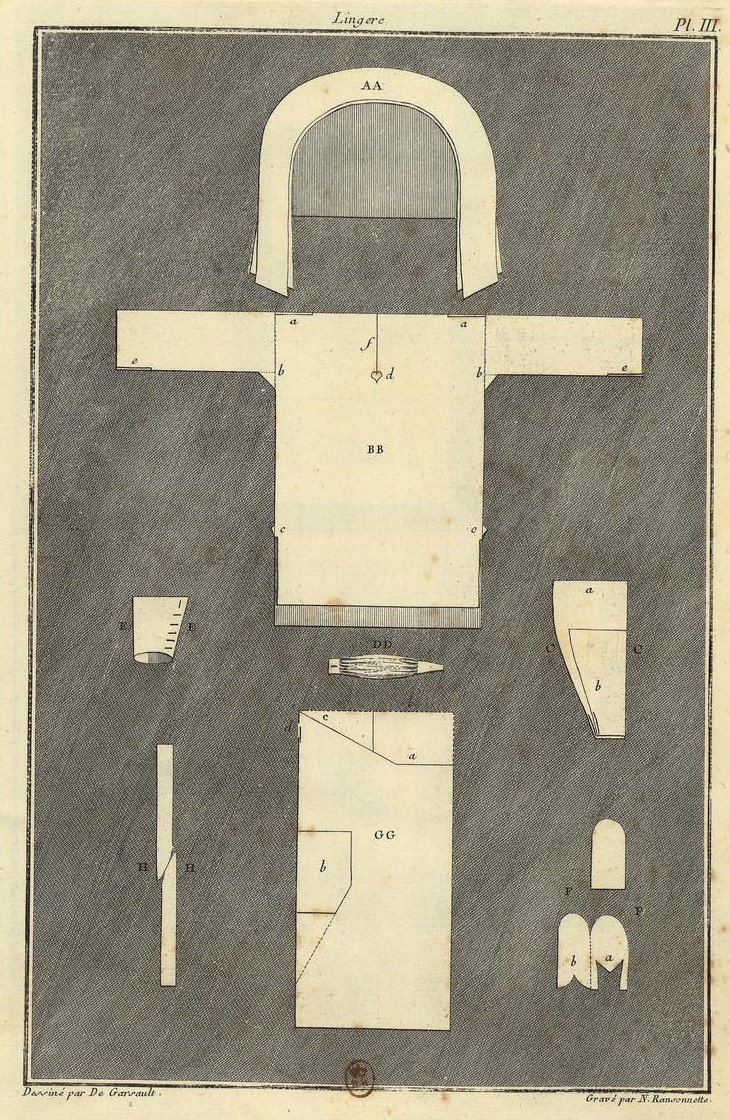
What is called the bassinet bow consists of three wooden half-circles which raise the head of the bassinet and serve as a canopy. This bow is covered with linen.
These requires a piece of Cretonne an ell wide. Each cloth is two ells long.
See the same section in the trousseau chapter.

 Mimic of Modes