
In July, I was honored to attend the wedding of a friend out on the west coast, and spent a week sight-seeing. I went to the Tenderloin Museum just a few blocks from my hotel (the Andrews Hotel, I really liked it) and to Lacis out in Berkeley. It was so wonderful to see my friends IRL, and it was just a fantastic vacation in general.
I hadn’t planned to go to the de Young on this visit as I went there a year ago, but at one point I saw a poster advertising Fashioning San Francisco – and, well, I have to go see the fashion show, of course!
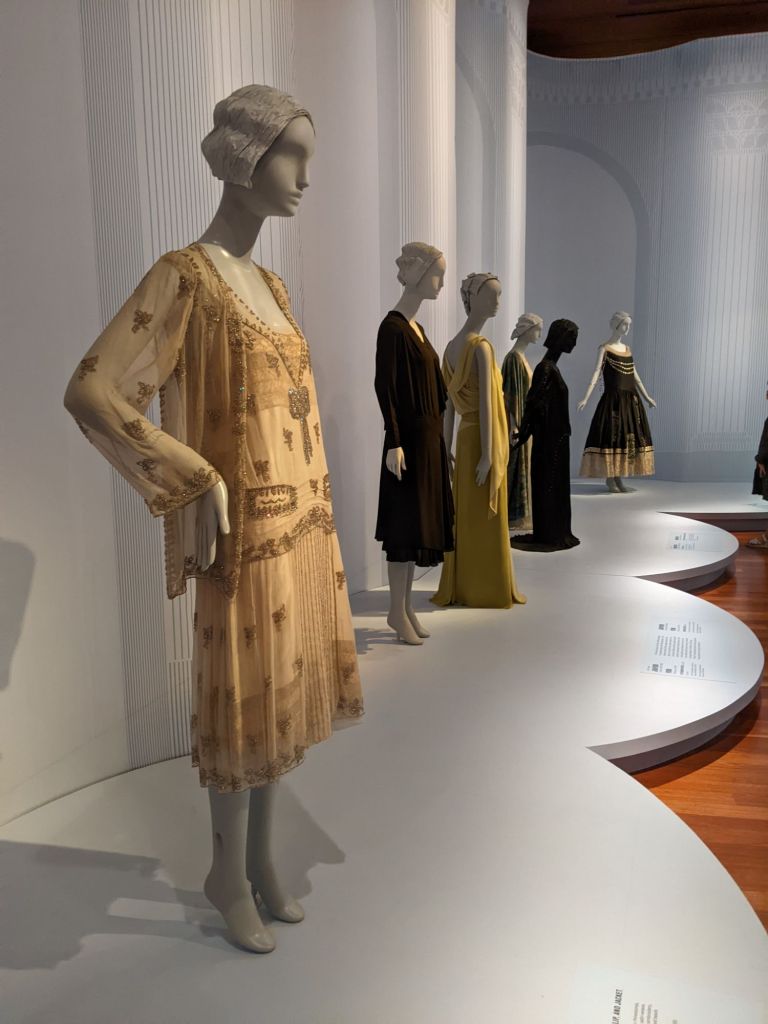

The show opened with a small display of several gorgeous historical pieces from about 1900 to 1930, from some very familiar names: Fortuny, Lucile, Lanvin, etc. (That one on the right in the lower picture is actually by Blancquaert, a house I’m not as familiar with.) These had a rather plain presentation with a generous amount of space between them, so it was a bit of a surprise to go through into the main exhibition space …
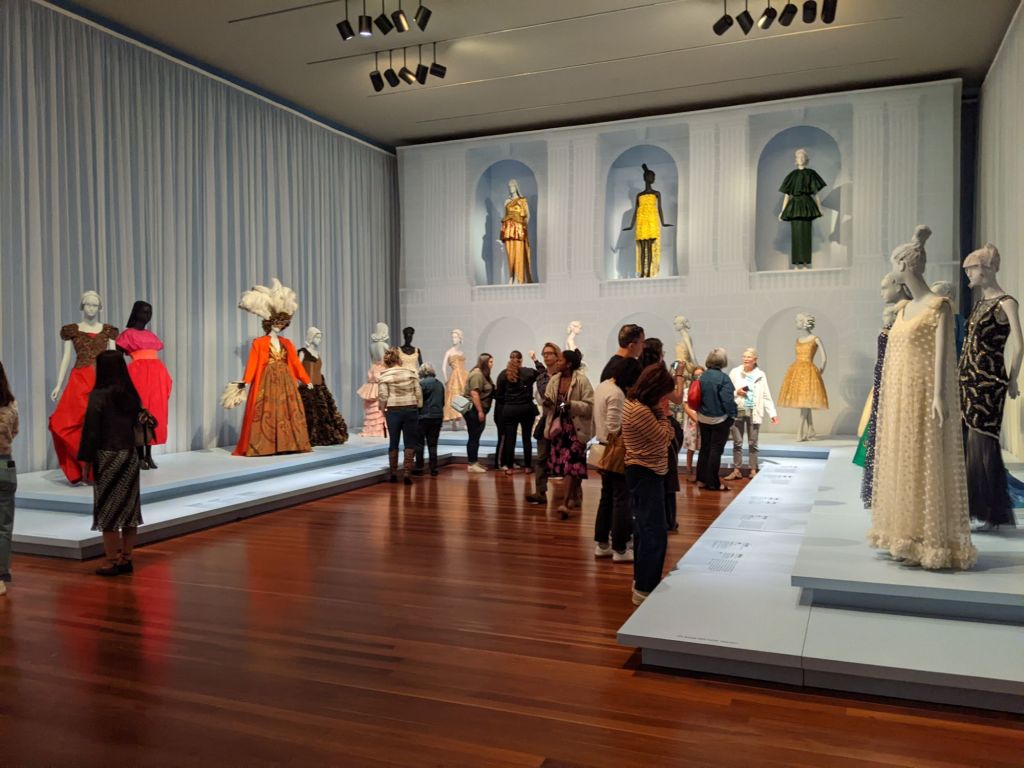
… which is very dramatic! These mannequins are dressed in couture from the 1930s to the present day, arranged in groups with some dynamism and flow between them. It’s bright and attractive and fun, and the crowds that were attending the show at the same time as me seemed to really be enjoying it!
As you can see, some are even placed in alcoves in a second story – similar to the Met’s recent “Sleeping Beauties” exhibition. That gives some extra room for mannequins without losing any floorspace, but also makes it hard to see some of the pieces. They add to the ambience and make for fabulous photos, but I’m sort of questioning the point of dressing mannequins and placing them so high that most people standing nearby won’t look at them and people far enough away to see them won’t be able to make out any details.
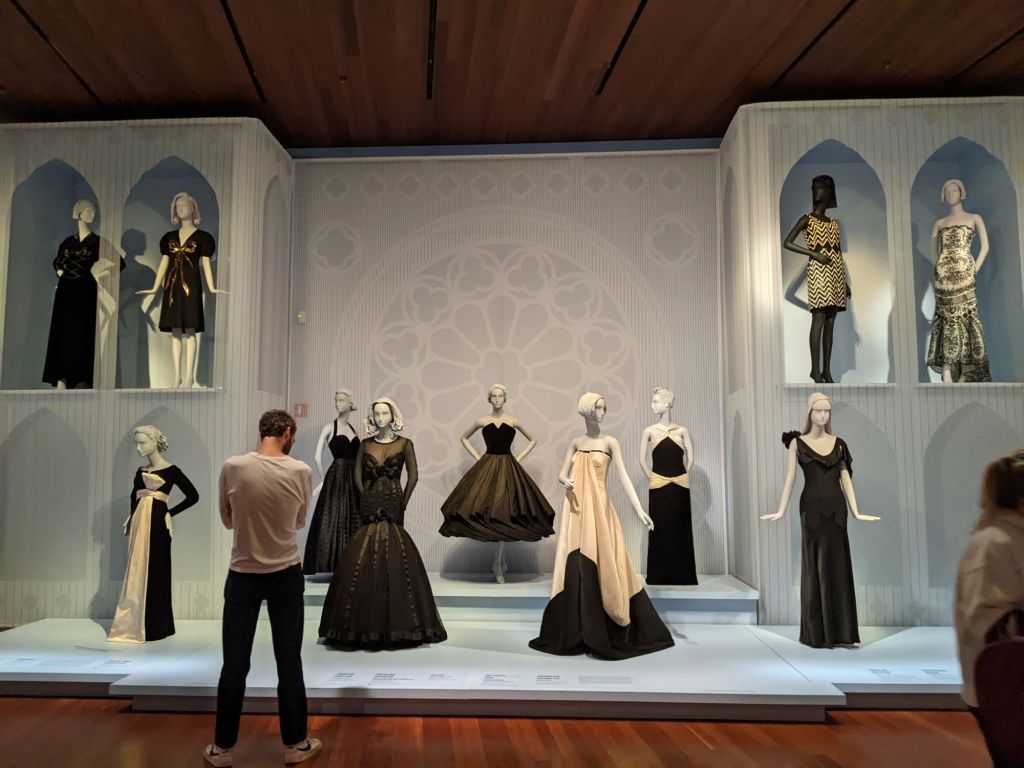
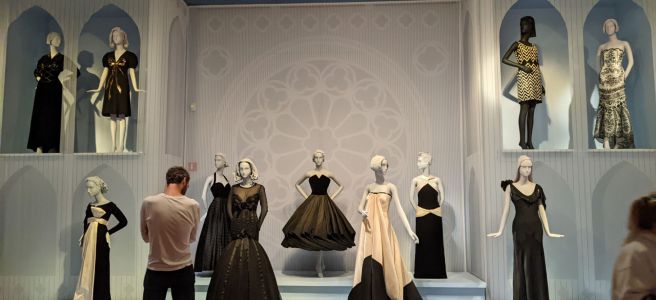
The main show was divided into sections: “The Little Black Dress: A Fashion Staple”, “After the Ball: Formal Wear in the Big City”, “Well-Suited: Upending a Sartorial Standard”, “Avant-Garde: Fashion as Art”, “Global Aesthetic Influences: Life on the Pacific Rim”, and “Best Foot Forward: Shoes and Identity”. Clear concepts, and every garment selected fit the bill for each area, forming extremely attractive and well-designed tableaux.

However … of course, I have criticisms. The intro text to “Little Black Dress” thankfully did not credit Chanel with the concept, but still related it to twentieth century social changes, ignoring the popularity of the “best black silk” in the nineteenth century. “Well-Suited” presents a wide array of women’s suits, but doesn’t engage with the concept prior to the 1960s.
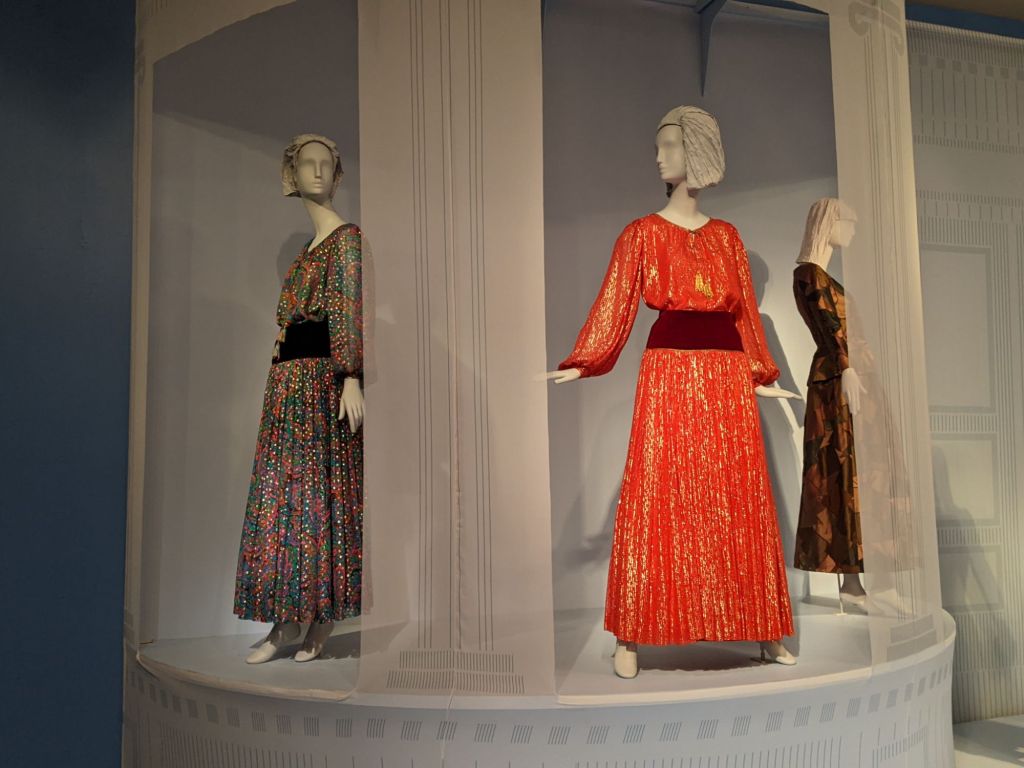
“Global Aesthetic Influences” remarked on cultural appropriation in the intro text and in occasional labels, but the treatment felt fairly shallow. A label briefly mentions the concept after describing how, for instance, Frederick Gibson Bayh actually used an antique Chinese dragon robe to make a dress for a department store; another says that Yves Saint Laurent’s collection based on the Ballets Russes “manifests Orientalism” with no explanation before talking about how it was a “watershed moment” in fashion.
It’s better to acknowledge these things than to pretend they don’t exist, but to acknowledge them without having anything else to say looks like you’re just trying to tick the box so you can go back to describing how important these couturiers are. To be fair, I do know what a struggle it can be to write labels for a whole show and deal with edits from multiple angles, and I know that many institutions are fundamentally small-c conservative and afraid to turn off viewers by appearing “political”; however, half measures can be turn-offs to both ends of the spectrum.
(Meanwhile, Chanel garments showed up repeatedly with no acknowledgement at all of Coco’s sordid history, which I did not like. I really think we’re at the point where curators shouldn’t include Chanel pieces unless they’re willing to deal with her toxic legacy.)

Ultimately, while I enjoyed the show as a feast for the eyes, I was a little disappointed with it. I’d hoped — and this is partly my own fault for not looking further into it than the title — that it would focus on the work of dressmakers from San Francisco, hopefully from the late nineteenth century forward, and what it really was was a collection of Parisian couture owned by San Franciscan philanthropists/museum donors. More pre-1930 pieces worked into the exhibition would have at least given me something to really look at while I walked through — and I know FAMSF has them, I can see them on their website — but there seems to have been a deliberate decision to sideline historical fashion in favor of modern haute couture, a splashy visual display meant to be seen from a distance over interesting detail to inspect up close. It’s part of a worrying* trend among museums with substantial fashion collections to treat more recent fashion as “art” and more historical clothes as “artifacts”.
* Well, it’s worrying if you’re a historian who specializes in pre-1930s fashion and would like to be a curator, anyway
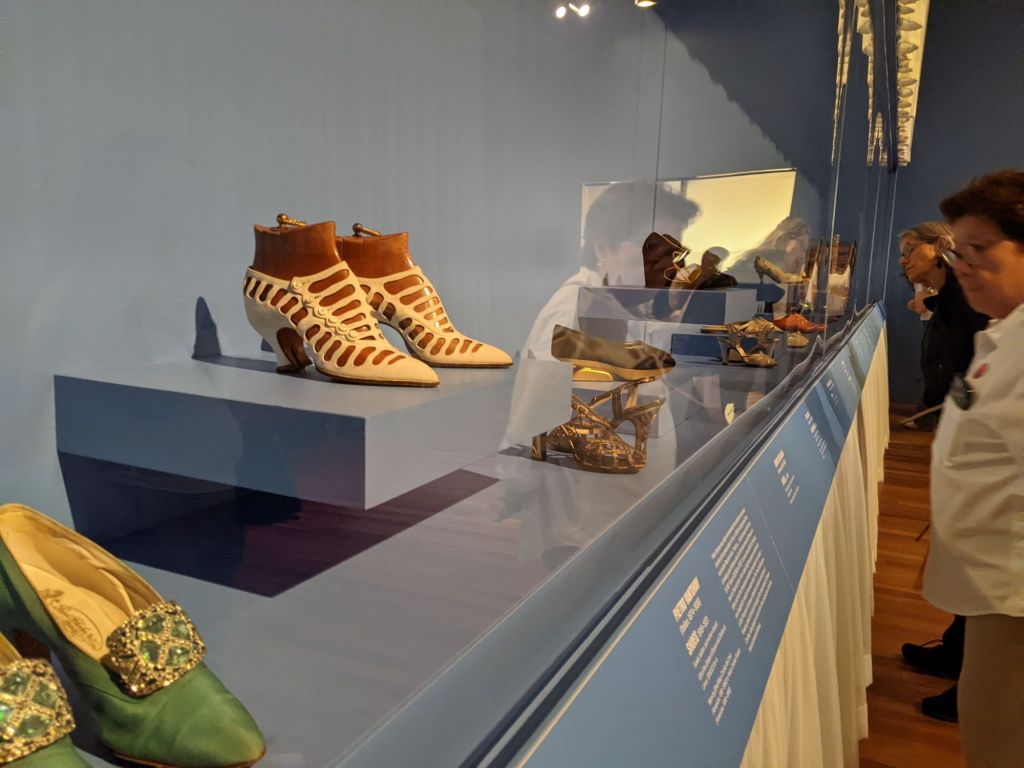
The shoe section felt a bit like an afterthought, placed sort of outside of the main exhibition, but I really liked it! Much more low-key than the rest of the show, it seemed like they’d given this space to a member of staff who wanted to contextualize objects rather than just displaying them. It was a lovely conclusion with some gorgeous pieces.

 Mimic of Modes