
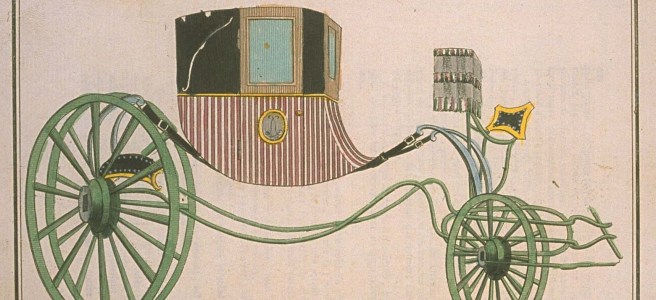

A Diligence or Cut Carriage.
Though this form of Carriage may have been adopted long ago by the French, we put it here among the English Designs because it is that Nation that we owe for it, and it is fair to render them honor for their inventions.
The Cut Carriage only differs from Long-Square Carriages, called Vis-à-Vis, that we showed in the eleventh Issue of the first Year, and the Wide-Square Carriages that we showed in the nineteenth, in that it only has a bench in the bottom, and that it is cut right after its door. Sometimes an over-the-bridge bench is added in front, but this bench not being an essential part of the Carriage, it does not take away the name of Cut Carriage.
As it must only have a bench in the base, and must only hold two people, it must be very light; this is why it is called a Diligence.
For the interior decoration of the box, for the suspension, for the belts, for the stretcher, for the reins, for the seat, for the step, it perfefctly resembles the two Carriages we showed last year. See those two Carriages, where in the explicative discourse we gave the origin of the Carriages, the times and places of their birth, their first forms, the different variations, their embellishments, their increases, etc. etc. …
A very ancient and powerful fashion which reigns over a great number of slaves, who desire to be able to free themselves from its heavy yoke; a fashion which, against the nature of all the others, maintains itself with such strength that its birth goes back to the most distant past; a fashion that we ourselves have already cursed many times, is that of giving New Year’s gifts (étrennes). How many people mutter, and how few people rejoice, when their time comes again!
This fashion (some can call it a tradition), we have received in part from our ancestors the Gauls, and in part from the Romans, who possessed the Kingdom of France for a long time. It is commonly believed that the name comes from Strenua, Goddess of Strength. On the day of her feast, the Romans greeted each other with a reciprocal exchange of tree branches and strands of vervain. When the luxury was introduced to Rome, figs, dates, and honey were substituted for tree branches. Suetonius (in the life of the monster Tiberius) reports that this Emperor defended giving étrennes after the calends of January. Soldiers formerly gave them to their Generals; Students to their Teachers; Clients to their Patrons, etc. The custom of sending bouquets to parents and friends on the day of their birth or their saint’s day cannot seem to us to have another origin. The first Christians, through a pardonable zeal, first raised themselves against the tradition of étrennes as drawn from Paganism; they later became accustomed to it. This tradition has passed without interruption to us, and it will probably always be maintained as long as subordination based on fortune, name, and age continues.

 Mimic of Modes