
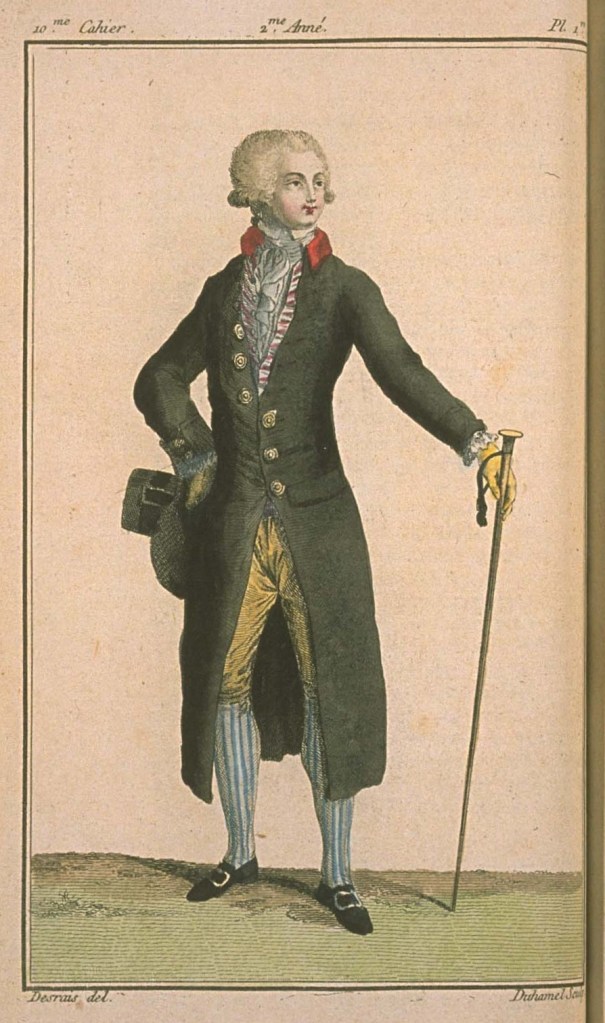
It would be too little for Fashion, which is known to be so light, so inconstant, for people to only change it after a certain amount of time, after epochs, until disgust can arise, and has already arisen; it still wants to change several times a day. That’s why it’s taken on the morning coat, the dinner coat, the evening coat.* It would not complete our mission to only paint full-dress coats, or dinner and evening coats. After having given these others so often, here is a morning coat, as it is worn while going about one’s business or making friendly visits, or taking a promenade in the morning. We could, because of its shape and length, call it a redingote-coat.
The one that we’ve represented in PLATE I is of London chimney soot-colored wool, with very long skirts, buttonless pockets, a scarlet velvet collar, and sleeves à la marinière.** It is buttoned with the three last buttons, and the top is left very open. Its buttons are silver, very flat, and with colored circles on top.
The Man who is dressed in this redingote-coat wears underneath it an unbleached linen-colored satin waistcoat with melted stripes of soft pink; breeches of canary-tail Cassimere wool; and silk stockings, with white stripes and melted blue stripes.
A full cravat goes around his throat three times, and after having formed a knot in front is allowed to descend, and its ends hang very low with the jabot of the shirt.
The shirt is trimmed with sleeve ruffles and a jabot of fine muslin, all plain, with very wide flat hems; and the collar of the shirt, very high, falls rather low over the cravat.
His hair is frizzed in a large square grecque, split in a horseshoe at the back, and with three front curls on each side. His hair, in the back, is tied in a long and very thin queue.
The buckles of his shoes are silver, in very large squares; and his garter buckles are of silver rushes in rectangles.
His hands are covered with gloves of yellow chamois leather. In one, he holds his jockey hat, with a high crown, belted with a very wide ribbon, which is held with a very long polished steel buckle; and in the other, a cane trimmed with a long golden pommel made in the shape of a mushroom, and a black silk cord without tassels.
We do not need to say that the lining matches the redingote-coat; it can be seen rather well in the Print. Today it is agreed upon by the Disciples of Fashion that linings should only be non-matching with dress coats; and that for undress, frocks, redingote-coats, and simple redingotes, matching linings will be used, or something near it. As is already far from the fashion of non-matching linings and piping that we announced in the Issue from the first of June last year; recalled, so to speak, from past centuries, this fashion seemed, for this time, to promise a long reign by the taste that it had given a rebirth!
This redingote-coat is worn much more than frocks or undress. Often the frock or undress coat is underneath, and of a color matching the redingote. Very often it is in a different color. In the latter case, one can show more ostentation, and in the former, more taste, with more simplicity. This fully shows that taste walks independently from ostentation. Though this truth may be trivial, by dint of being said, we do not believe that it may be misunderstood by repeating it again, because very few people seem convinced.
* At the end of the eighteenth century, “dinner” was still a meal in roughly the middle of the day, and “evening” was the period after it.
** Tight, long sleeves fastening with buttons at the wrist.

 Mimic of Modes