

This is a concept I’ve had issues with for a long time. I don’t tend to think about it (as I prefer to think we’ve moved past it as a field), but a couple of weekends ago it came up in a paper at an event I was attending and I started trying to formulate A Response to the thing.
What is the Renunciation, you might be asking? Well, it’s a theory developed by James Laver in the early twentieth century positing a monumental shift in menswear around the time of the French Revolution. In this paradigm, men’s fashion before the Revolution worked along the same lines as women’s, with men showing off their power and wealth through sumptuous displays of silks, laces, embroidery, wigs, etc. Following the Revolution, men cast off this aristocratic ideal and began to emulate a middle-class look, with austere, dark clothing, relegating the very concept of fashionability to women.
And, okay. There is certainly a shift in how men dressed around this time (largely due to the fact that that’s what fashion does, even for men).
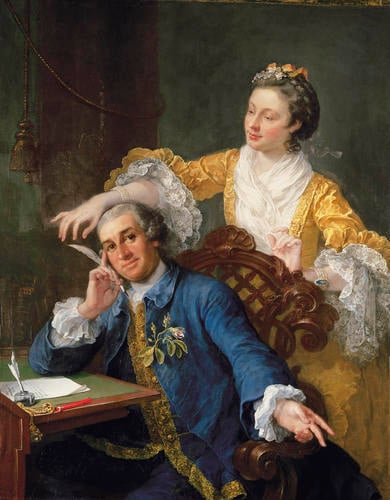

But this narrative is simplistic, trying to force a moral out of the complex reality.
Ultimately, it’s based on a presentist value judgment splitting historical menswear into “the times when clothing looks weird to me” and “the times when men wore what I recognize as normal”. Laver was a scholar, but he was also a prisoner of his own era, born at the end of the Victorian era and spending most of his life in a period in which somber three-piece suits were required dress for men outside the most casual situations. We shouldn’t look at him as an objective authority, but as a person with his own context, and evaluate his work historiographically.
Part of why I say this is presentist is that there are a number of aspects of men’s clothing post-Renunciation that can easily be understood as flamboyant, sumptuous, and impractical if we try to look at them from an objective viewpoint (to the extent that objectivity is possible, given that we all have biases and personal perspectives, etc. etc.) rather than accepting them as “normal” masculine dress. For instance:
- Elaborately tied, starched white cravats
- Shining silk top hats
- Narrow waists set off by full sleeves and padded chests
- Richly colored silk waistcoats
- Tight pantaloons that follow the shape of the leg
- Blue coats with white trousers
- Suits made of brightly checked fabric
- Fair Isle sweaters and plus-fours
And on the other side, the idea that there was essentially no standard for masculinity in dress and appearance that we would recognize before the turn of the century is flawed. Britain and other northern European countries had sartorial standards for men that prioritized subdued colors and general restraint, which was the entire issue behind the stigmatization of the macaronis: Englishmen were supposed to be plain dressers who took pride in their lack of interest in flamboyant clothes, while those who broke this rule were seen as overly influenced by nefarious French and Italian forces, and potentially too much like women. (Check out Pretty Gentlemen: Macaroni Men and the Eighteenth-Century Fashion World by Peter McNeil for more on this!)
All in all, it’s a concept that makes sense from the whiggish, universal-law standpoint of the early twentieth century, but it doesn’t seem to have any use now that we’re looking at fashion history less as something that needs to uphold a broader narrative and more as a valid field in its own right. It hides more than it illuminates, and we should probably put it aside.


 Mimic of Modes