
The anglaise, française, and polonaise are the most commonly talked-about types of 18th century gowns. However, fashion magazines talk about loads of different styles: à la levite, à la sultane, à la circassienne … I’d like to do a post on some of these, looking at fashion plates and figuring out on my own what seem to be the defining features of each type. From here on in, I shoot without a script.
[Edit, 1/14/2013: Newcomers, you may want to see my tag for the circassienne, which will show you all of the Galerie des Modes circassienne plates I’ve translated so far. They’re the same plates as below, but they have longer descriptions that I’ve also translated, that give the conclusions I took ages to get to here.]
So. The circassienne. According to Wiktionnaire, Circassia was a region of the Caucasus, on the coast.
Jeune Dame en Circassienne garnie de blonde, ornée d’un ruban tigré, coeffée d’un Chapeau galant avec un chignon lâche et tressé.
Young lady in a circassienne trimmed with blonde lace, decorated with tiger ribbon, coiffed with a gallant hat with a loose and braided chignon.
Jeune Dame en Circassienne de gaze d’Italie avec une juppe faite de la même gaze; le falbalat est orné d’un ruban de couleur; elle est coëffée d’un pouf au fichu garni de perles avec une plume sur le côté gauche, à la mode Asiatique.
Young lady in circassienne of Italian gauze with a skirt made of the same gauze; the furbelow is decorated with a colored ribbon; she is coiffed with a pouf with a kerchief trimmed with pearls with a feather on the left side, in the Asiatic fashion.
Circassienne de taffetas à bandes de rubans avec la juppe d’une autre couleur garnie de gaze à petits plis ronds, et ornée de trois grandes bandes de rubans de couleurs différentes.
Circassienne of taffeta banded with ribbons on the skirt in another color decorated with gauze in little round leats, and decorated with three large bands of ribbons in different colors.


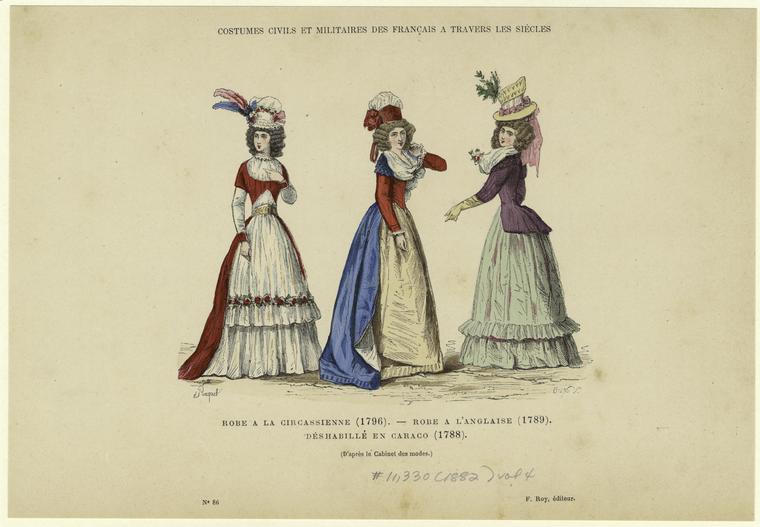


Again, 1860s, but it seems to mesh with what I’ve been finding in fashion plates, as it’s been copied from one above. Oh, you sly dogs!
A Short Glossary of Clothing Terms describes the circassienne as “variation of a polonaise: short funnel sleeves, through which fitted sleeves of undergarment drawn through.”
In Eighteenth-century French fashion plates in full color, Stella Blum says that the lévite and the circassienne have the same cap sleeves. (Page x.) But this seems to be the only mention of the circassienne in the whole book. In Fashion in the French Revolution, Aileen Ribeiro correctly notes that it’s a version of the polonaise, and says that it’s not only short sleeves but “‘oriental’ trimmings such as fur and tassels” that distinguish it.
Conclusions: In general, the styles referred to in fashion magazines aren’t governed by enforced rules – different fashion plates can contradict each other. Who knows whether 18th century women were annoyed by this or had their own standards for determining which styles were which! But it also seems possible that sometimes artists and label-writers could get mixed up and draw a turque when asked for a circassienne or mislabel a picture. I strongly feel that that happened a couple of times above.
At the very least, a circassienne-style dress had to have the same back and skirt as a polonaise, trimmed all around the skirt. The sleeves seem to have been different as well in the majority of these fashion plates – of the ones that don’t have ordinary sleeves, the plates seem to be evenly divided between short mancherons over longer, more fitted sleeves and full sleeves held in with bands, sometimes in two parts (an upper sleeve and a lower, white sleeve).
I tend to agree with Ribeiro that the “oriental trimmings” were important to the definition. Nearly all of the plates above show at least one tassel somewhere on the bodice or the skirt. (I don’t think I’ve ever disagreed with Aileen Ribeiro.) The trimmings in general on these plates appear to be fussier, in my opinion, than those on the polonaises. “Oriental”, in the period, can mean quite a lot of different things, and I wouldn’t be surprised if those applied flowers and such were considered exotic.
(Fashion plates thanks to Dames à la Mode, Titam, and 18th Century Blog!)


Hallo.In case you're interested: this is an article on authentic Circassian dress:http://www.circassianworld.com/new/culture/folklore/1379-circassian-costumes-jaimoukha.html-Zeina, a Circassian 😉
LikeLike
Wow, thank you! That's a very thorough article.
LikeLike
Hello Cassidy, I found your posts about these dresses very interresting when I read it. And now I'm making some research about the origine of the french word “Circassienne”. My first research seams to drive me to your conclusion; the terms deals with Orientalism. But can you tell me what was the text you quote when you said this? I'm very curious about it. I will link to your post when I'll publish my conslusions on the true sens of the word in french littérature.
LikeLike
Ooh, exciting! The book where I found the specific orientalism connection was p. 28 of Aileen Ribeiro's Fashion in the French Revolution; you can see snippets of it on Google Books, so you shouldn't have to track down a physical copy.I'm torn between totally fixing up this page and asking you just to link to the main page of the blog … I feel like these early research pages are kind of sloppy. Check back with me in a bit!
LikeLike