

I watch Bridgerton. This probably isn’t surprising — I’m well aware that I’m in the main demographic the show’s aimed at, given my age, gender, and interests.
But I’m not usually that into the show, because it uses so many romance/historical fiction tropes that just don’t work for me. The third season has been a pleasant surprise, though! This is largely because it may be Francesca Bridgerton’s debut Season, but Penelopre Featherington is the actual main character, and she’s a fresh and interesting character. Romance novel heroines rarely have a) secret jobs that earn money, b) terrible relationships with their entire family, even their sisters, and/or c) bodies that are larger than a US size 8 at best. I adore Penelope and I’m so invested in her getting everything she wants in life even if it doesn’t make a ton of sense to me. (Did Colin get a glow-up on his Grand Tour? Sure. But he’s still Colin Bridgerton.)
At the other end my opinion spectrum sits Eloise Bridgerton. I know, it seems like this should not be the case! She and Pen used to be friends, she’s independent and resists marriage, I “should” like her. But unlike Penelope, she represents a really, really common type of character in historical romance: the thin and conventionally attractive heroine who believes strongly in women’s rights but does very little to advocate for them, can’t stand everyone’s focus on getting married but ends up hitched to a man of her rank or above, doesn’t care about clothes but dresses well, and loathes, absolutely LOATHES, embroidery. In a scene from the current season, she stands in a group of young women at a ball, listening to them list their favorite embroidery stitches in disgust.
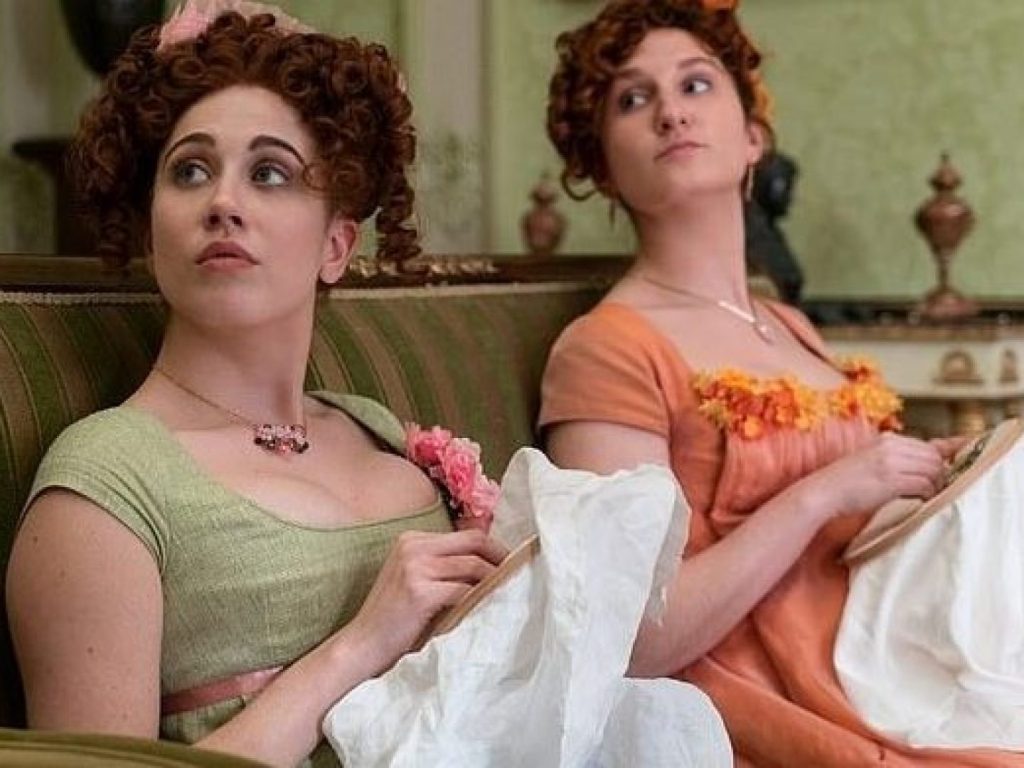
It’s not her fault. I don’t hate her as a person: my ire is entirely for the writers who keep reiterating her and creating foils just to make her look better.
Embroidery is routinely used in historical fiction to represent women’s oppression. And I ask, why? And what if it weren’t like that?

In the Regency period (to focus on Bridgerton specifically), gentlewomen and ladies were expected to cultivate skills in a number of fields that could be used to improve their homes but, crucially, would not be used to earn money. We call these “accomplishments”. A lady was accomplished if she could perform a number of these in a better-than-mediocre fashion.
“It is amazing to me,” said Bingley, “how young ladies have patience to be so very accomplished as they all are.”
“All young ladies accomplished! My dear Charles, what do you mean?”
“Yes, all of them, I think. They all paint tables, cover screens, and net purses. I scarcely know any one who cannot do all this, and I am sure I never heard a young lady spoken of for the first time without being informed that she was very accomplished.”
“Your list of the common extent of accomplishments,” said Darcy, “has too much truth. The word is applied to many a woman who deserves it no otherwise than by netting a purse, or covering a screen. But I am very far from agreeing with you in your estimation of ladies in general. I cannot boast of knowing more than half a dozen, in the whole range of my acquaintance, that are really accomplished.”
“Nor I, I am sure,” said Miss Bingley.
“Then,” observed Elizabeth, “you must comprehend a great deal in your idea of an accomplished woman.”
“Yes, I do comprehend a great deal in it.”
“Oh! certainly,” cried his faithful assistant, “no one can be really esteemed accomplished who does not greatly surpass what is usually met with. A woman must have a thorough knowledge of music, singing, drawing, dancing, all the modern languages, to deserve the word; and besides all this, she must possess a certain something in her air and manner of walking, the tone of her voice, her address and expressions, or the word will be but half deserved.”
“All this she must possess,” added Darcy, “and to all this she must yet add something more substantial, in the improvement of her mind by extensive reading.”
“I am no longer surprised at your knowing only six accomplished women. I rather wonder now at your knowing any.”
(From Pride and Prejudice.)
In a modern story set in the past, these are all typically winnowed down to embroidery. Crafts like netting are forgotten. Painting/drawing and playing/singing music are considered real art forms worthy of respect. (Francesca Bridgerton’s autistic special interest is the piano, and that’s fine in the narrative!) Speaking and reading foreign languages are worthwhile intellectual endeavors, although in the period such skills were almost never used by the women who learned them.
Embroidery, though? Almost always either forced on independent-minded women to make them be inactive and stultified, or done eagerly by insipid and unintelligent women whose brains can’t handle anything more complex.
A large part of this is that for centuries, embroidery and other textile work was conceptualized as central to respectable, traditional femininity. “When women embroider, it is seen not as art, but entirely as the expression of femininity,” says Rozsika Parker in The Subversive Stitch: Embroidery and the Making of the Feminine. As a result, it became both valorized as the province of the domestic, subservient woman and denigrated as something other than real art, which was made by men with oil and canvas. As a result, one can lean into the latter mindset in order to reject the former harder, treating embroidery as first and foremost the enforcement of a limiting version of femininity, because it has no other value.
That embroiderers do transform materials to produce sense whole ranges of meanings is invariably entirely overlooked. Instead, embroidery and a stereotype of femininity have become collapsed into one another, characterised as mindless, decorative and delicate; like the icing on the cake, good to look at, adding taste and status, but devoid of significant content.
(Parker.)
In reality, though? Women’s embroidery was a very popular hobby and form of folk art, and actual historical women who advocated for their own rights did not disparage embroidery, but rather defended and praised it.
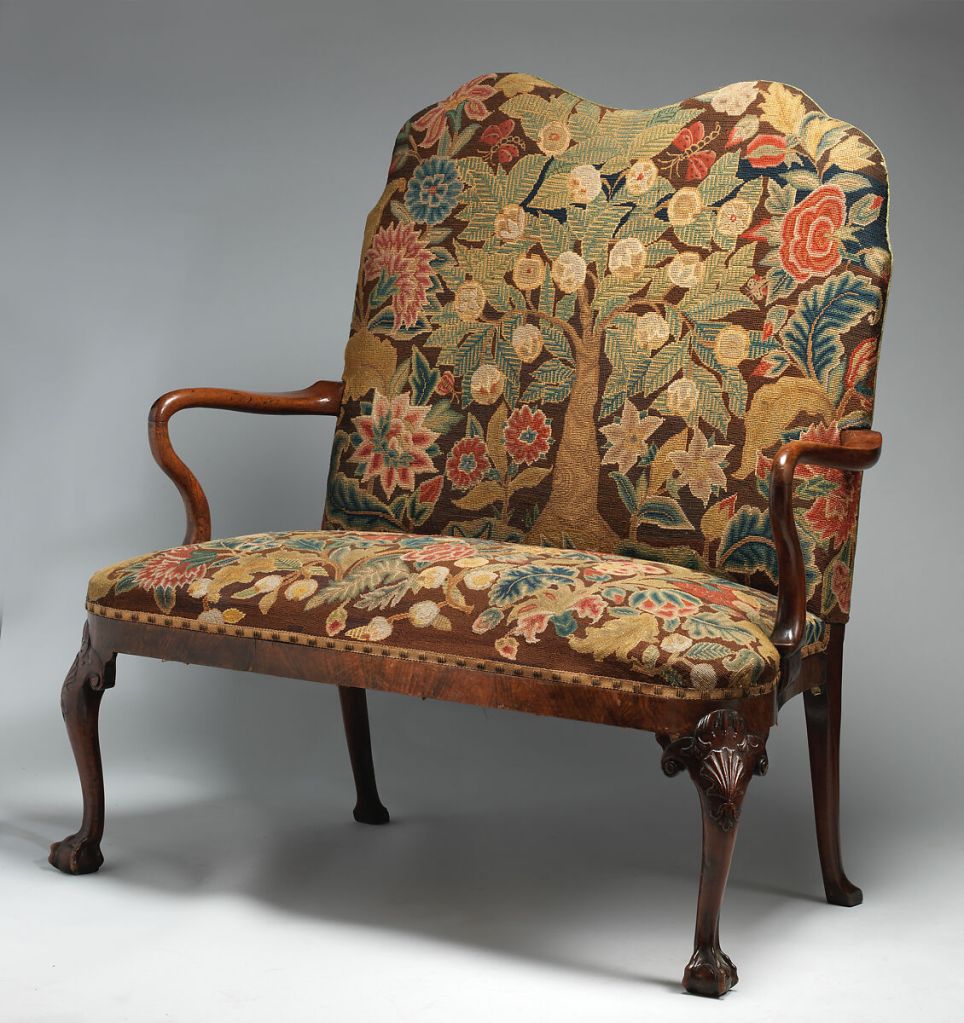
The diary of a Mrs. Anna Larpent records her embroidery of a set of chair seats in tent stitch for her own dining room, as well as other chair seats in cross stitch, and handkerchiefs, ruffles, aprons, and even a petticoat on muslin in tambour-work (chain stitch made with a special hook) in the early 1790s. None of this needed to be done: this was before the hard times caused by the wars with France, which made Mrs. Larpent dismiss her housekeeper and begin to focus on “useful work”, doing the mending herself and stitching shirts and waistcoats for her family to save money having them made elsewhere, though she still did some embroidery, such as a cross-stitched hearth rug. These earlier “fancy work” items were things she chose to make despite not needing to, in order to display her skill, imbue textile objects with more affection, and pass the time enjoyably. In 1797, she wrote that “had [the day’s mending] not been a duty how much rather would I have studied history or poetry,” but also that “fulfilling my female duties warms my heart as much as Mental pursuits delights it” and that “there is a monotony in X stitch and a cheerfulness in forming the various shades that soothes my mind.”
Another part of the main issue is, I think, related to the American fascination with the schoolgirl sampler.

Such samplers go back to the seventeenth century, the beginning of English colonization of North America, and as Americans have pretty much always been obsessed with the idealization of the colonial era, these have a strong place in the mythical understanding of the period.
They’re also not terribly complex, and they often don’t have much artistic merit. They’re typically done in cross-stitch and consist of alphabets, digits, brief (sometimes religious) couplets, and the name and age of the maker. It’s easy to look at these and see a mindless exercise designed to keep girls busy and indoors rather than artistry.
But these are schoolgirl samplers for a reason: they were made by young girls as a learning exercise. For the most part, the only textiles that were laundered in the period were household linens, like tablecloths, sheets, shirts, and chemises. As these were hard to differentiate (a white linen tablecloth is a white linen tablecloth), they would be marked with inked or embroidered initials and numbers in order to track them and make sure they ended up with their original owners. Samplers taught girls how to make these initials and numbers. They were not really meant to be considered on their artistic merits, or to be done by anyone older than about thirteen. I can’t imagine Maria Lalor’s sampler above took more than a week to make.
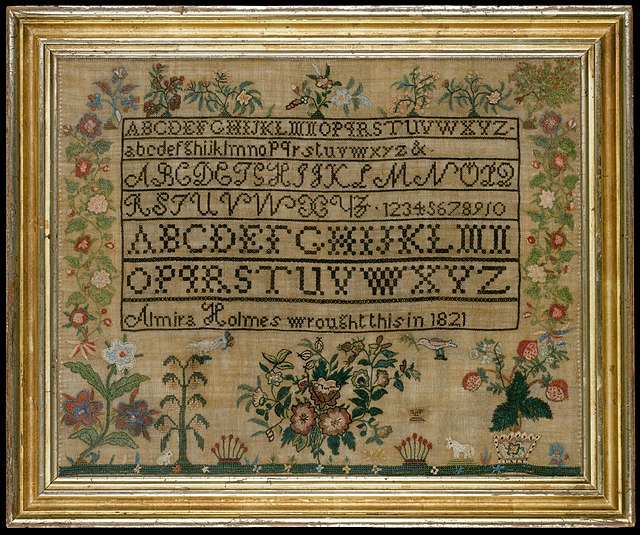
At a higher level of ability or a school that taught more types of art, some girls might combine their basic marking practice with embroidered images like those on the above sampler or even needlework pictures that copied popular prints or required original composition. And here I think we have to recognize the artistic sensibilities in both making the design and executing it. This is not dull, rote work done by girls who resented their needles, but something on par with painting or drawing — perhaps not their favorite activities, but something they took seriously and developed skill in, and an end result that was admired and also taken seriously.
This is not to say that all female characters should be written as loving embroidery. Characters are individuals, and there are certainly reasons why many characters would not be into it. They may not like the association of prolific embroidering with the idea of being a good woman, or they may hate sitting still and doing anything that involves looking closely at one thing.
In either case, though, I would expect such a character not to see embroidery itself as evil or contemptible. She could still perceive and appreciate the skill that went into it, just not want to do it herself or see women who couldn’t do it be mocked as unwomanly; she might also show a dislike for any sedentary pursuits and spend more time outside walking and riding. And the writer should avoid making any woman who discusses her embroidery a completely tedious idiot. (Seriously, listing their favorite stitches, which happen to be all the stitches you might find in a basic “how to embroider” pamphlet?)
What’s especially strange to me is that this characterization continues to be common even as embroidery makes a resurgence as a modern form of art. (Just look at what you can find on Tumblr and Instagram when you search the term!) We can recognize the incredible skill of modern painters in thread, but for some reason when transplanted into a historic setting, it becomes so easy to just dismiss the entire idea. And that’s unfortunate.
Some references:
The Subversive Stitch: Embroidery and the Making of the Feminine, by Rozsika Parker (BPC Book, 1996)
“‘After they went I worked’: Mrs Larpent and her Needlework, 1790–1800” by Mary Anne Garry (Costume vol. 39, 2005)


What fun! That was an interesting perspective, a “deep dive” on embroidery. I forwarded to my friends Dan and Lynne, who’s daughter Laura you should connect with some day.
LikeLike