
I’ve always meant to finish documenting my one fashion history exhibition at the Fenimore Art Museum, both for personal reasons and so that there is any record of these garments and makers existing on the internet, but somehow never got around to it. But now that I’ve left my position there, it feels like time to wrap this up.
Elegant New York was a showcase of clothing documented to makers in New York State, usually because of the existence of a label with the maker’s name/business and address. Drawn from the Fenimore’s extensive collection, they demonstrate almost a century of fashion and represent a bridge between ourselves and long-forgotten dressmakers of the past.
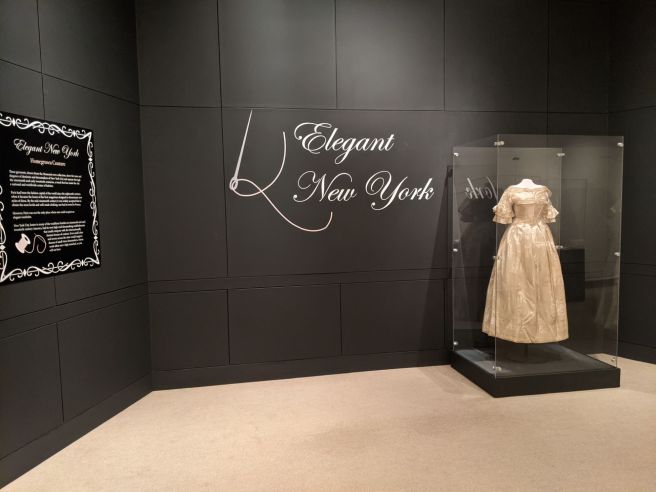
This is the only piece that I succeeded in writing up when I was planning to do a post on each garment, so I won’t go into too much detail here. Made by Jane Warnock, who worked in lower Manhattan, this is the earliest dressmaker’s label (well, stamp) that I know to be in existence.
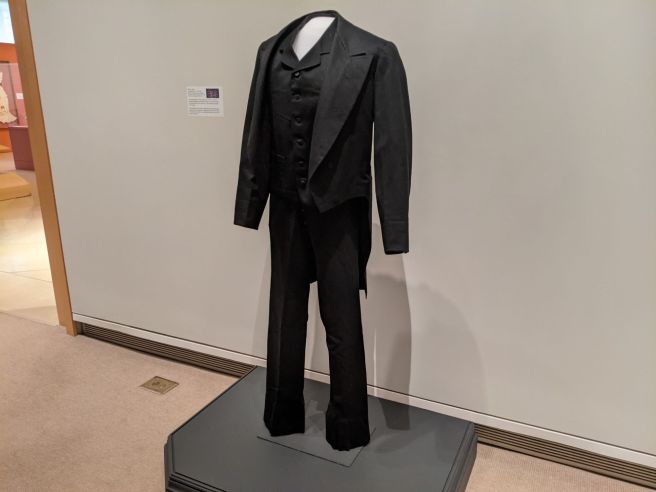
The next display in the show was a three piece men’s suit from A. Raymond & Co., also from lower Manhattan (the corner of Fulton and Nassau streets, just a few blocks away); Aaron Raymond’s merchant tailor business opened in 1857, and ran to at least the end of the century. A tailcoat can be a difficult thing to date, as it was a deliberately fossilized fashion, but I believe this suit dates to the earlier years of the company’s existence.
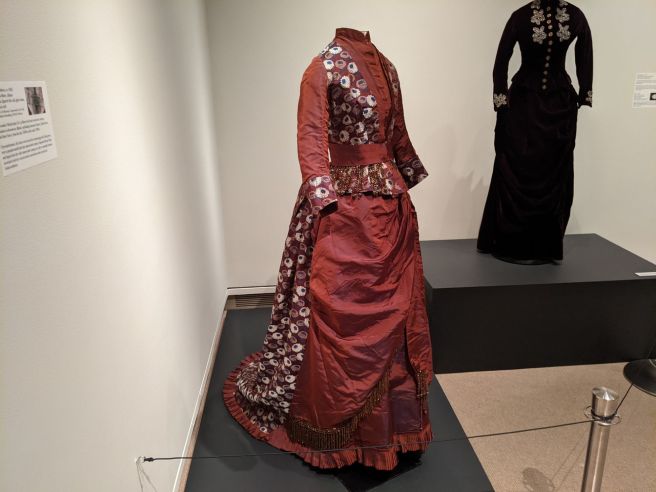
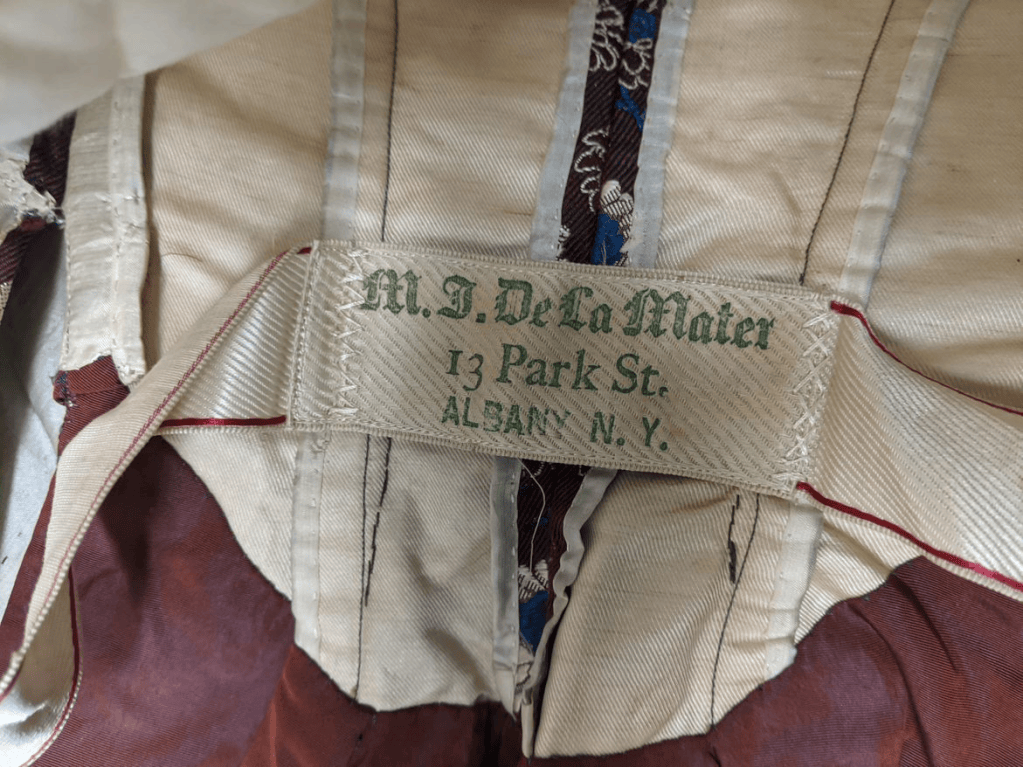
This gown on the left was made by Martha Jane De La Mater (1832-1900) in the 1870s, judging in part by the address woven into the label, as she moved premises multiple times around the city of Albany. (I wish I could find all of my notes, because I tracked her progress from Lancaster Street to Park Street to State Street from the late 1860s to the early 1890s, and would love to lay out that whole narrative for you. It would also be a good reference for anyone who finds another of her gowns and wants to date it by the label.) Her father was a tailor, suggesting that she came to her trade as a family business.
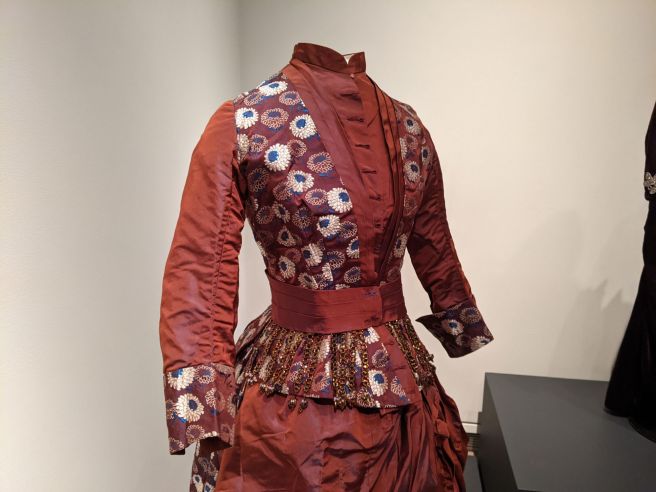
The eagle-eyed might recognize that a copy of this gown was worn by Cynthia Nixon in the first season of The Gilded Age …
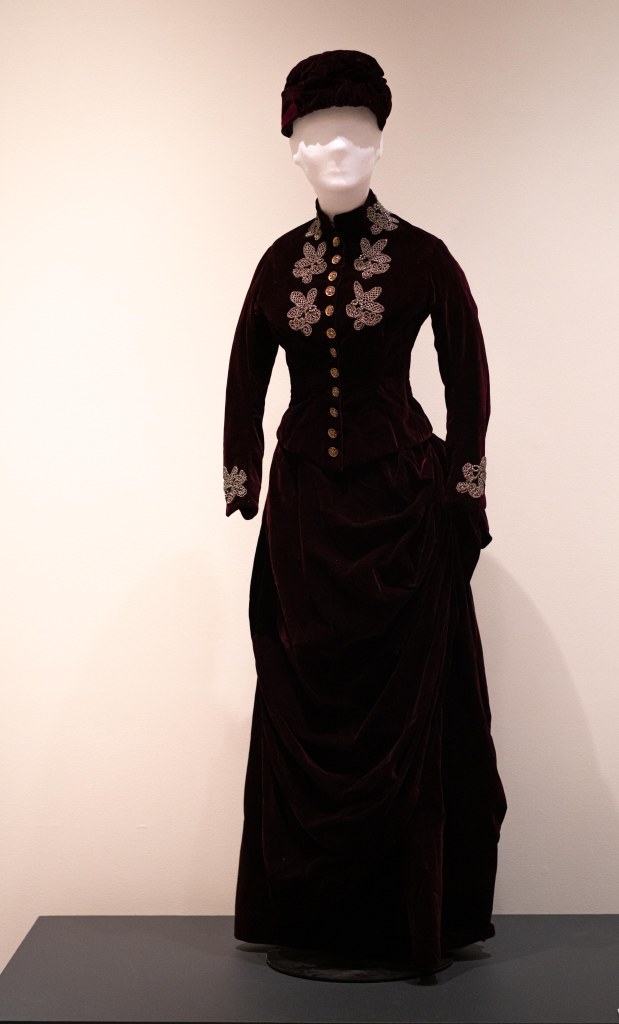
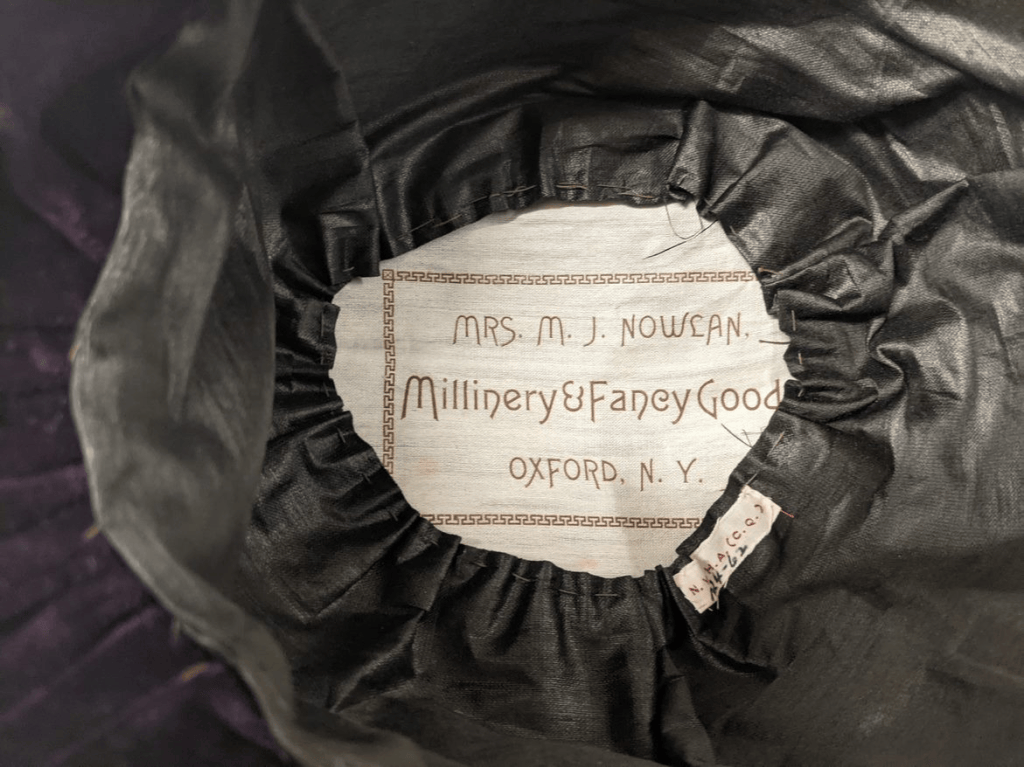
We don’t actually know who made this wine-colored velvet suit, which was the 1882 post-wedding going-away suit for Catherine Sands Packard, the daughter of Sarah Muggatt Sands, who wore the wedding dress at the top of the page. The hat that went with it, however, has a label from Mrs. M. J. Nowlan. The daughter of Irish immigrants, Margaret Lett Nowlan ran a millinery shop in Oxford, NY from about 1881 to 1910. After closing her shop, she became a chiropractor.
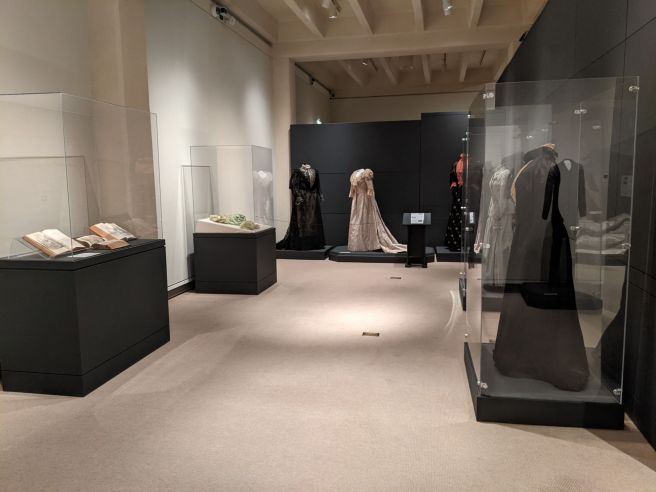
A look down the left side of the exhibition …
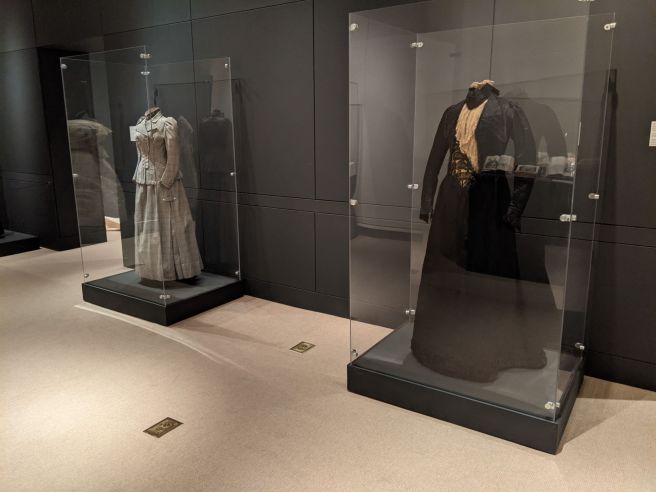
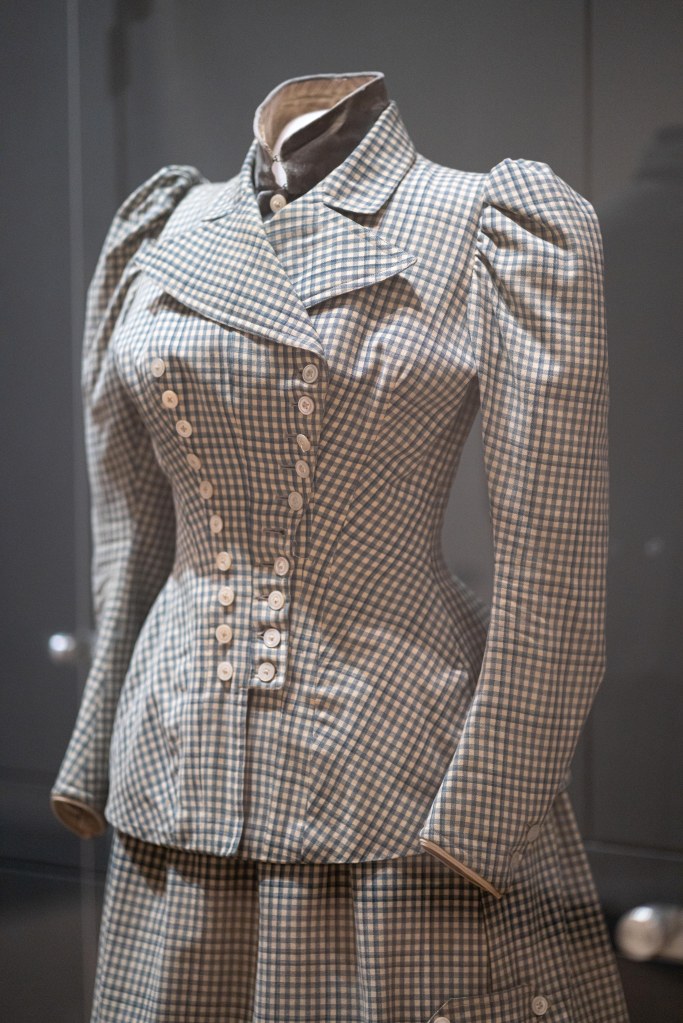
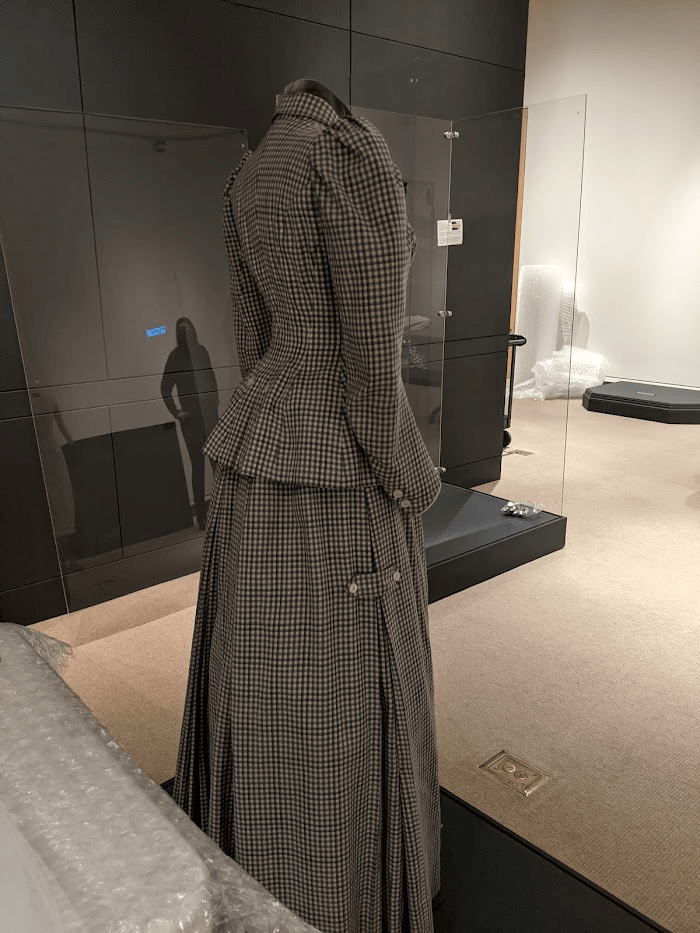
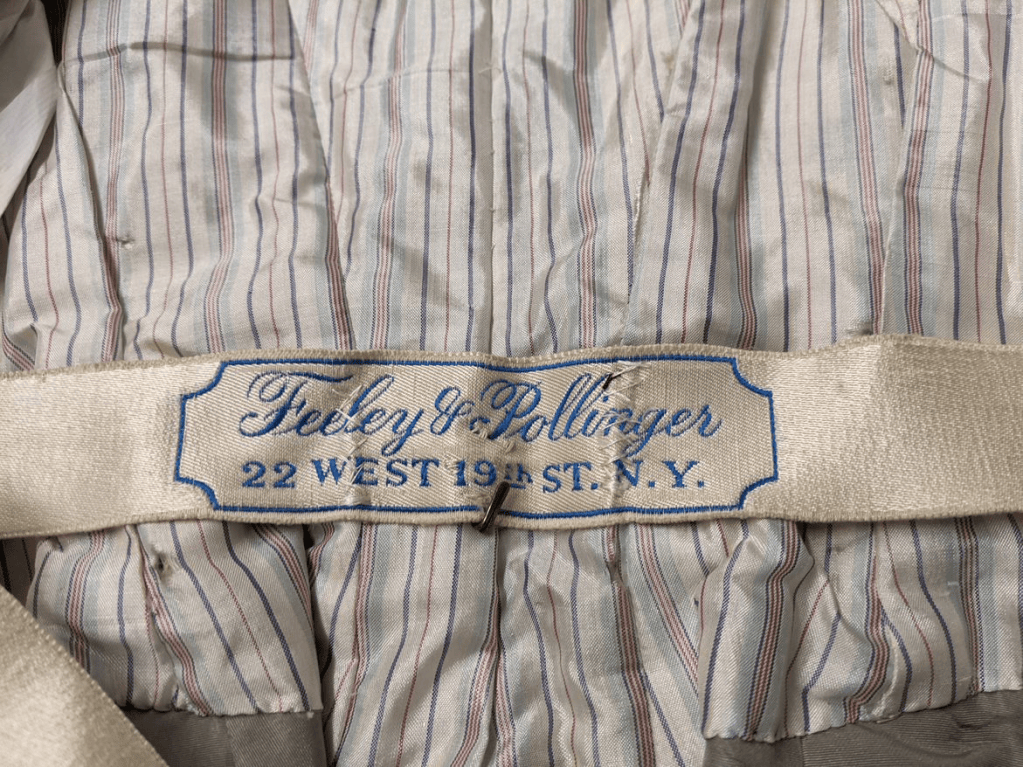
I love this suit, which I’d previously dressed for a general “winter stuff” shoulder season exhibition. Dressmaker Mary T. Feeley and ladies’ tailor John Pollinger ran a business together at 29 (per city directories) W. 19th St., New York, in the early 1890s. By 1893, Pollinger had left for another location on E. 20th, while Feeley continued her dressmaking business on W. 19th. The partnership was probably good for the customers, even if it didn’t work out for the two themselves, since women could get both gowns and tailor-mades in the same establishment. This particular piece would have been handled mostly by Pollinger; the lining that hides all of the seam allowances is a tailoring technique.
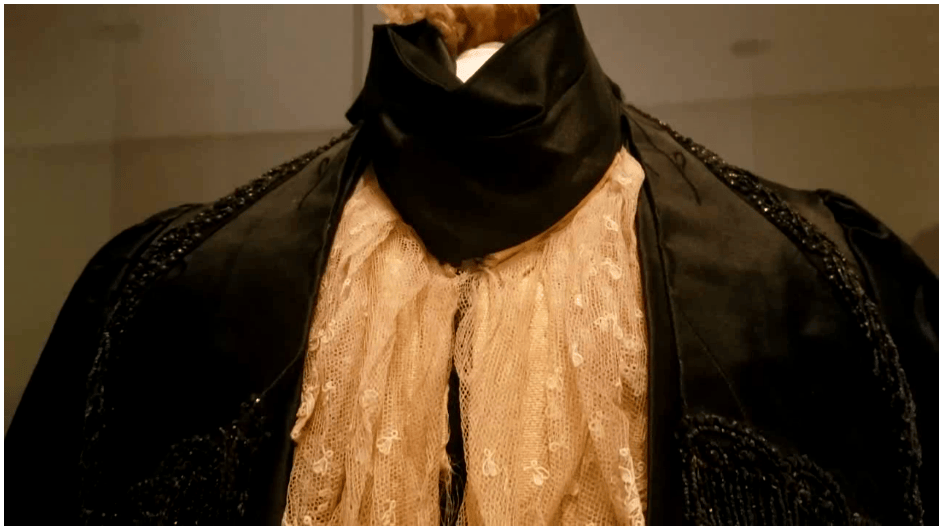
The other one in that hallway didn’t thrill me so I don’t seem to have good pictures of it. It has a label from dressmaker Catherine Tracy, who worked out of 25 W. 55th St. in the early to mid-1890s, but by the end of the decade she was no longer listed in the city directory, though I would put this gown at about 1899. The one thing I did like is that the satin is figured with a woven design of pansies or violets.
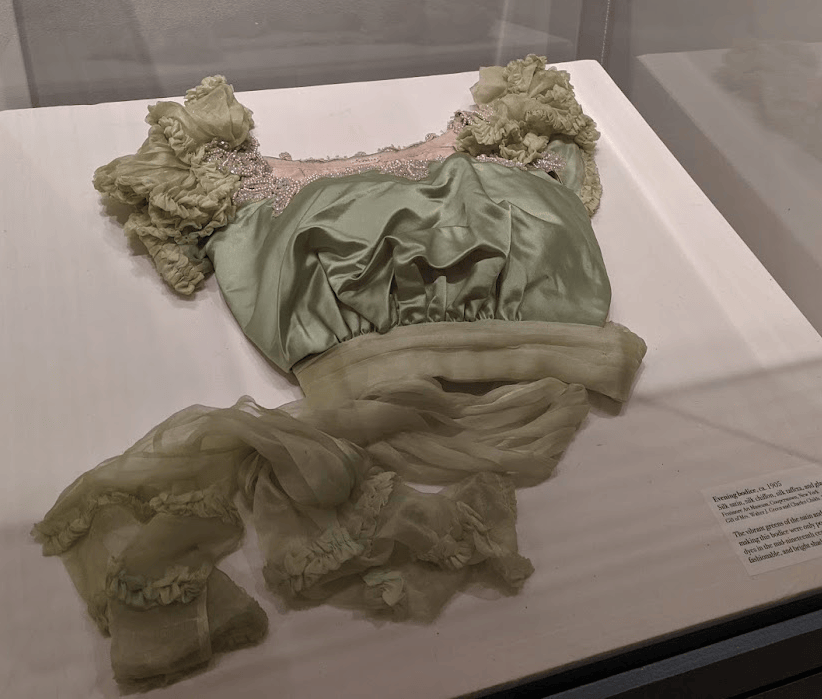
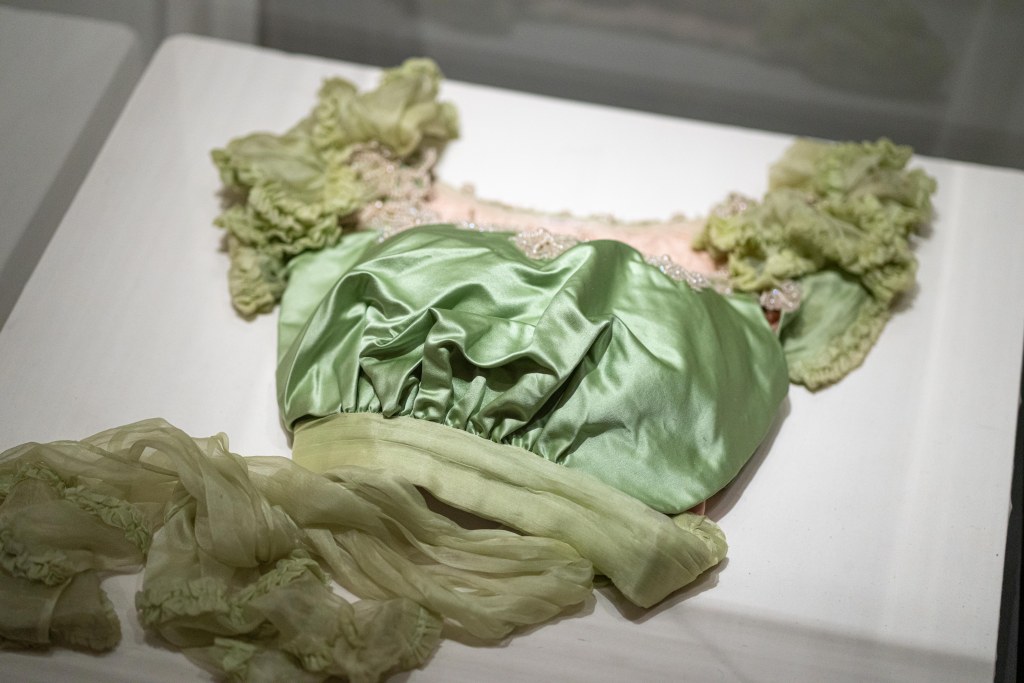
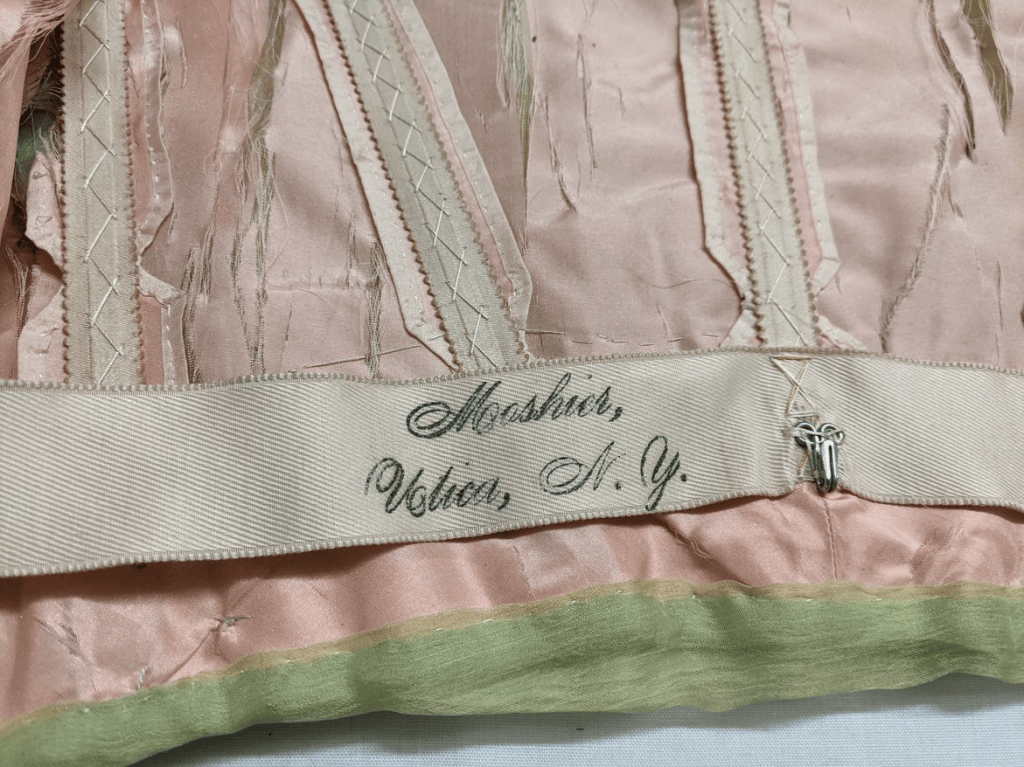
This poor evening gown (skirt not on display) is a victim of the practice of weighting lighter silks with metallic salts, which unfortunately results in them degrading and shattering horribly. It’s always a sad thing, and particularly tragic here, as the gown would have been stunning on a dress form.
Hattie and Nettie Moshier were both listed in the 1891 Utica directory as dressmakers living at 28 Chatham Street (now called Linwood Place) with a Mrs. Eliza Moshier, perhaps their mother. By the end of the decade, only Eliza remained to carry on the business.
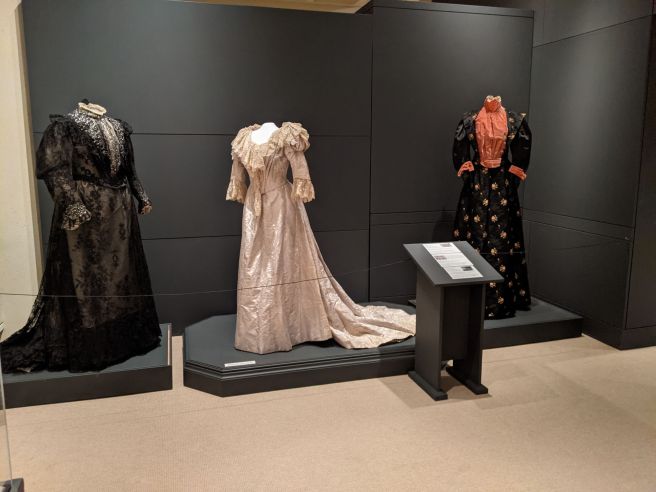
The three at the end of the space.
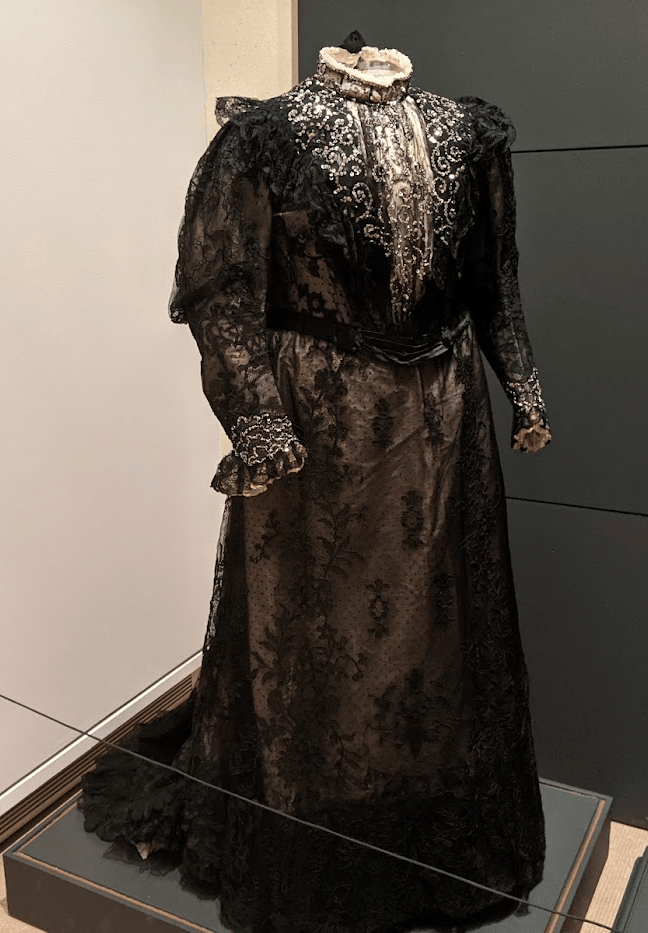
This gown — probably intended for dinner dress — was made by a J. Brennan at the end of the 1890s. Unfortunately, all that I know about her is what I could find on the label: that she had a shop at 50 E. 30th St. in New York City. It’s of interest to me because it’s a larger size than you will typically see in a historical fashion exhibition.
Placing the lace layer over a contrasting white silk allows the viewer to see every detail of the sheer textile and appreciate its fineness and expense. The lace ruffles at the top of the sleeves hint at the full sleeves that had just gone out of fashion.
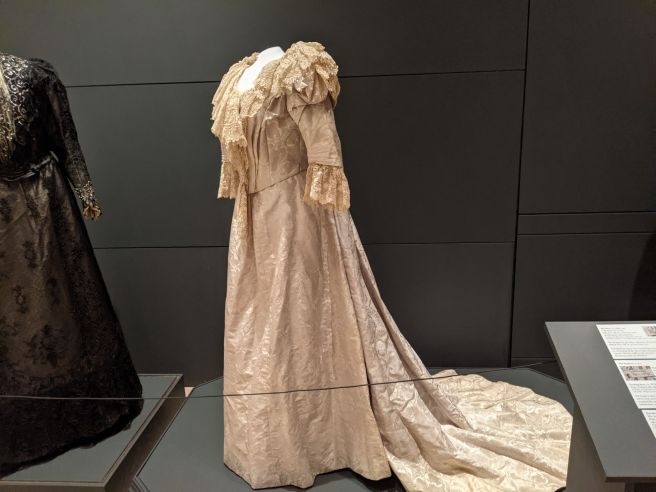
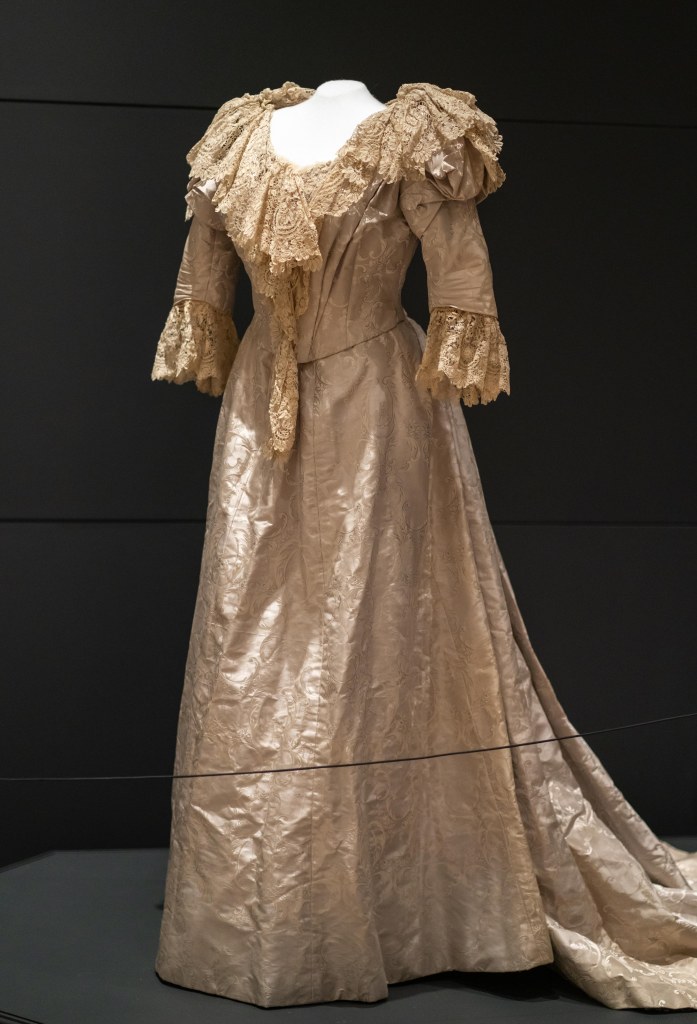
This gown is another Moshier creation. I struggled to date it at first because it combines aspects of the early 1900s and the 1890s; eventually I decided that it was post-1900 but for an older woman who was not on board with every aspect of Art Nouveau style and was continuing to wear an older-style corset.
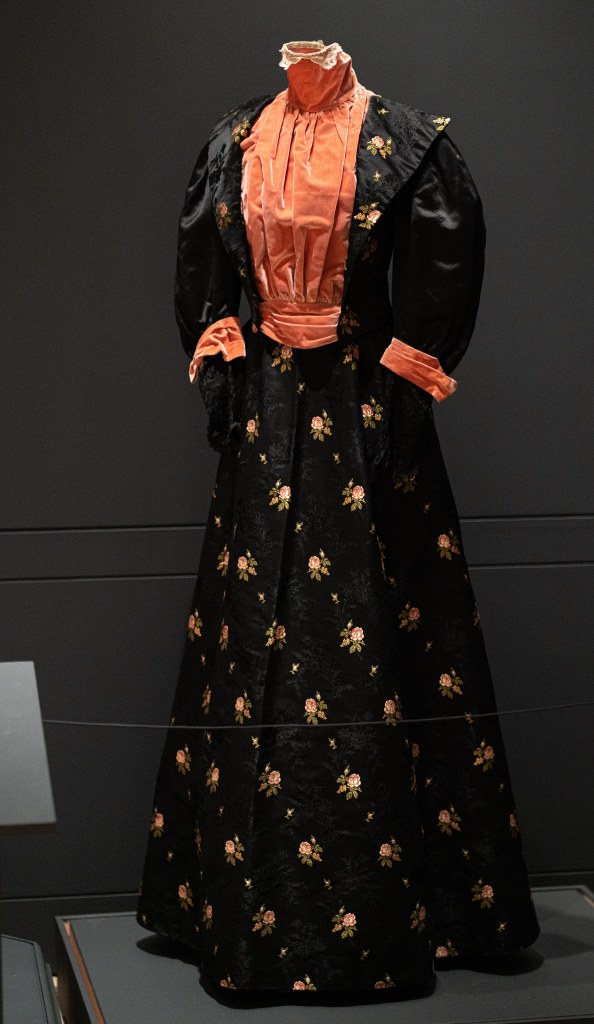
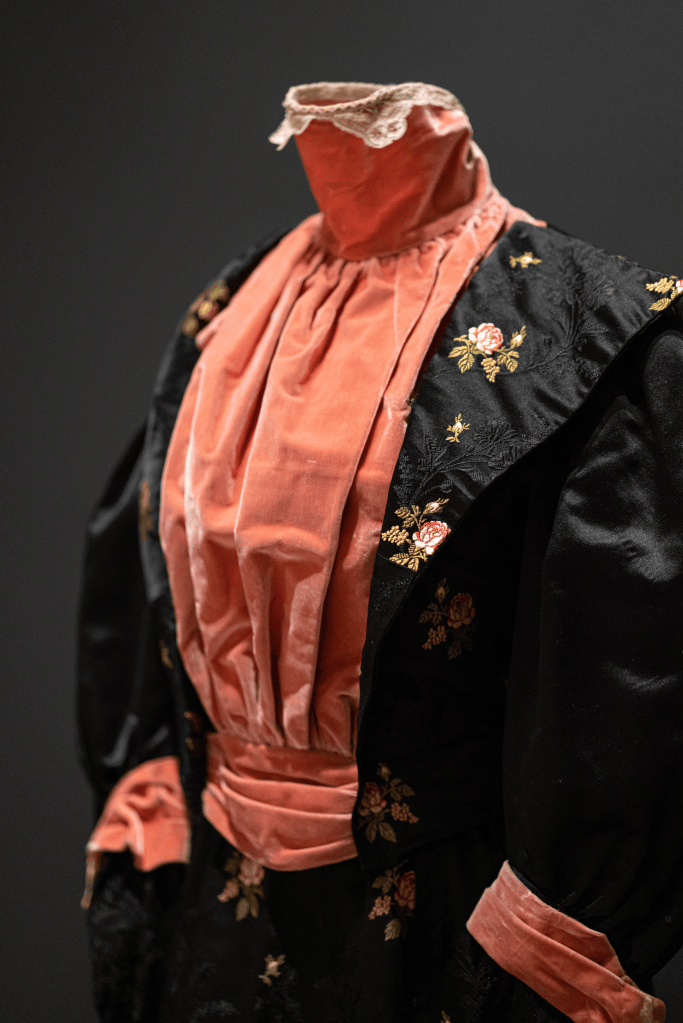
Really, all three of these in this group are mysterious. This one has a label with the name “Mrs. Jordan” and the address 250 W. 51st St. (in New York City), and while I was able to find a number of women with the surname “Jordan” active as dressmakers in the mid-1890s, none of them were at or even near that address.
The gown was owned by Anna Treadwell Keese, a descendant of the Cooper family.
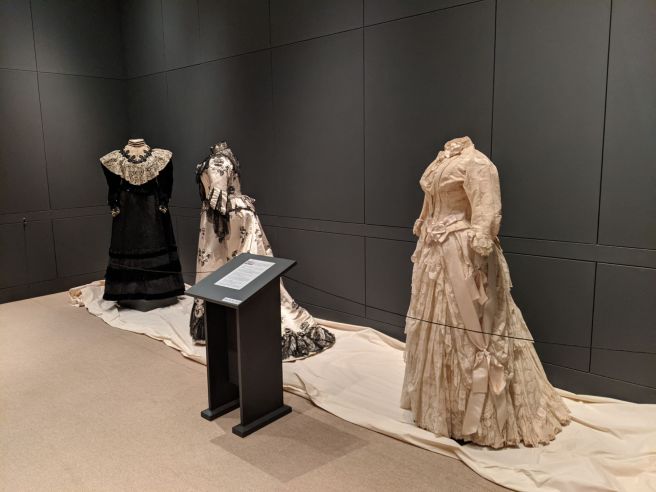
The muslin on the ground was an artistic choice made by the Exhibitions department to protect the gowns from the carpet; there weren’t enough platforms to put all of the dress forms on.
These three were all made by Mary E. Clancy. She was in business with an M. E. Curran in the early 1870s, but by the mid-1880s, she was working alone at 52 E. 21st St. It’s difficult to find these women in the censuses when they have very common names! They are also (along with several of the others in this show) part of the wardrobes of a set of sisters from Utica’s high society, Sarah K. Swartwout Green and Anna Swartwout Phelps.
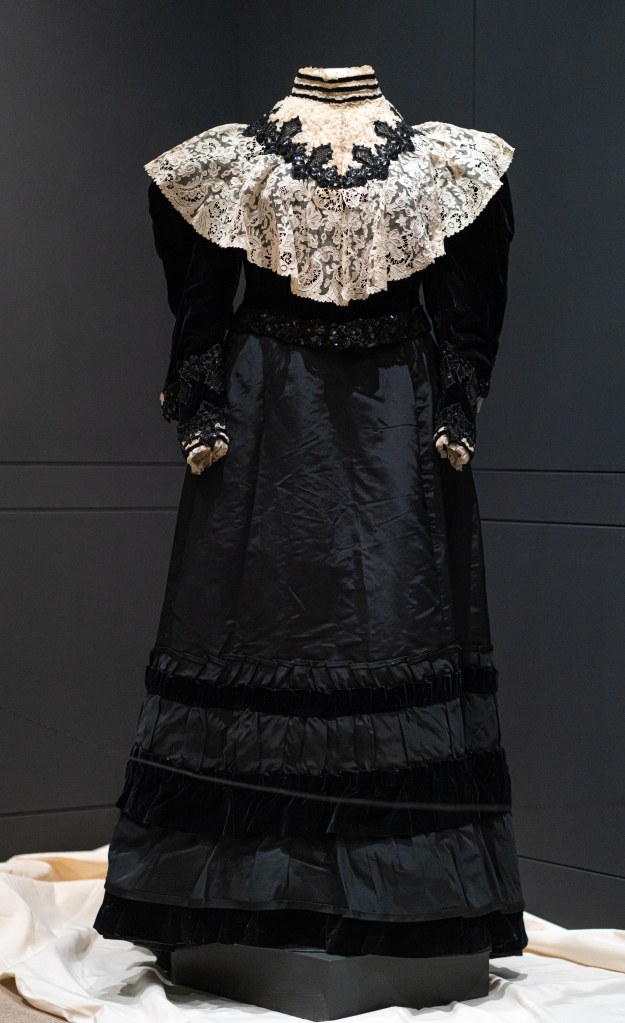
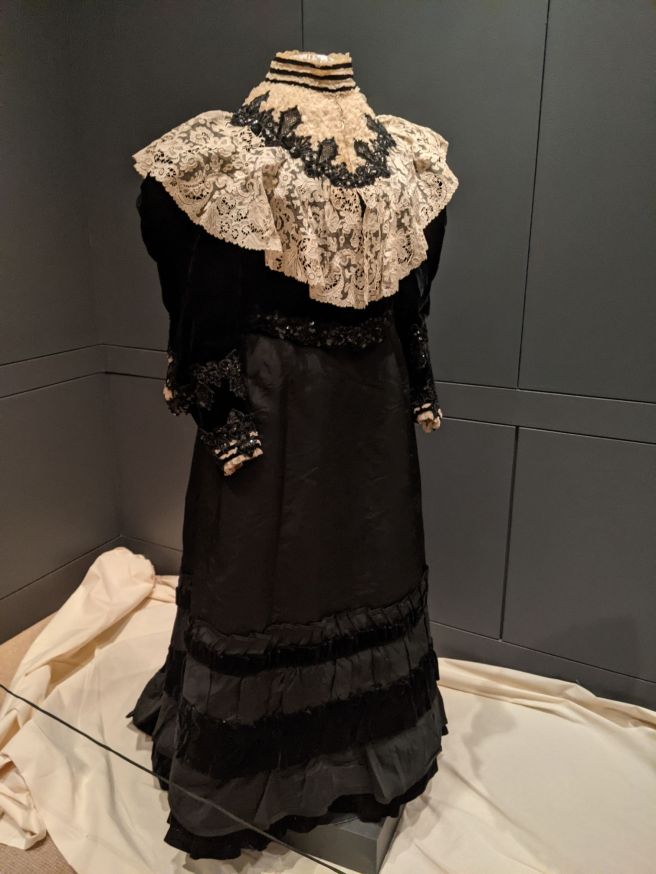
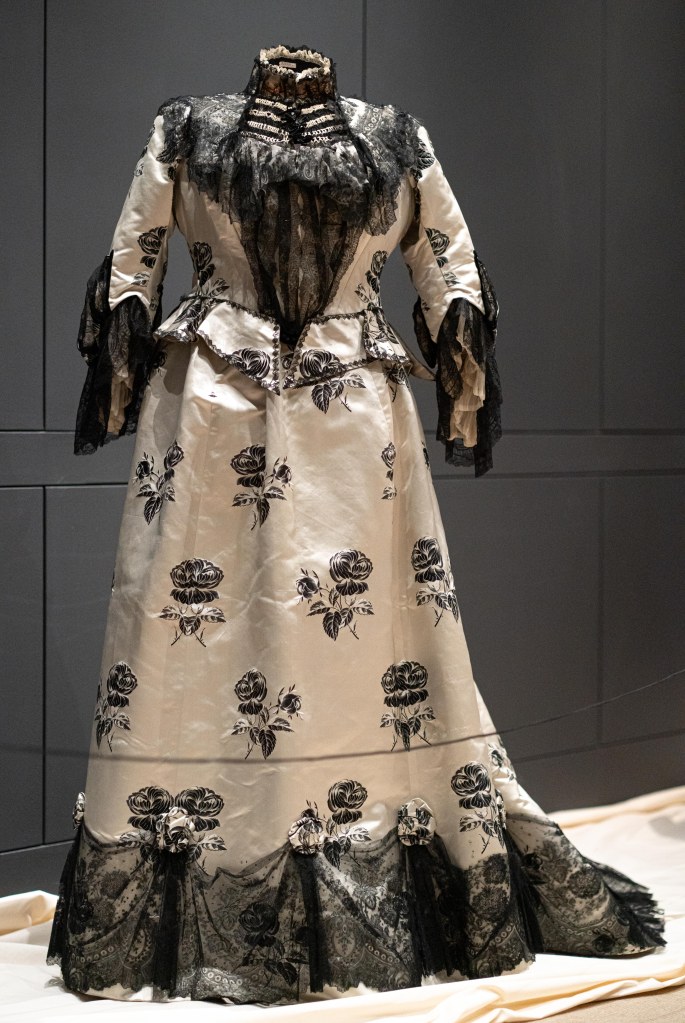
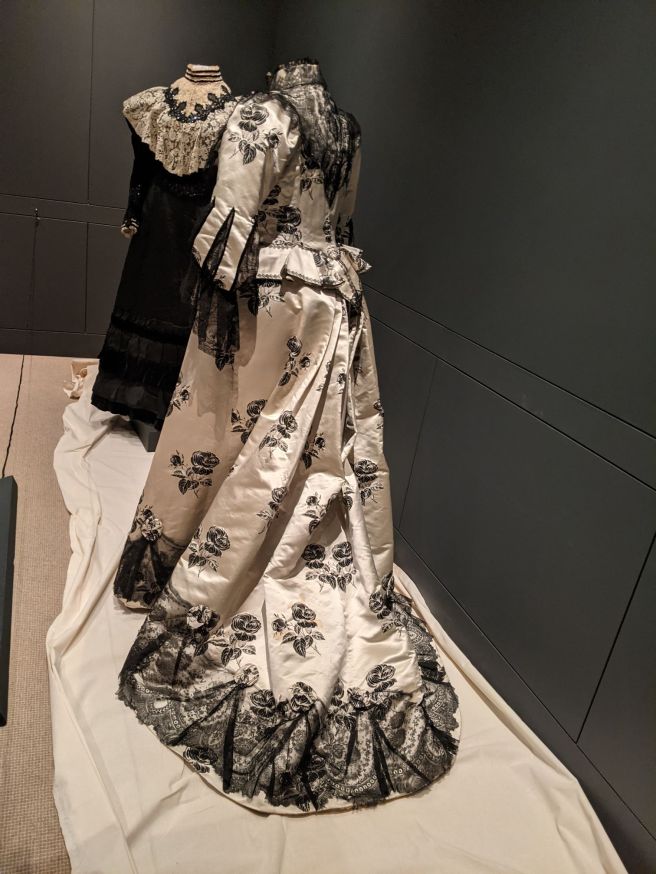
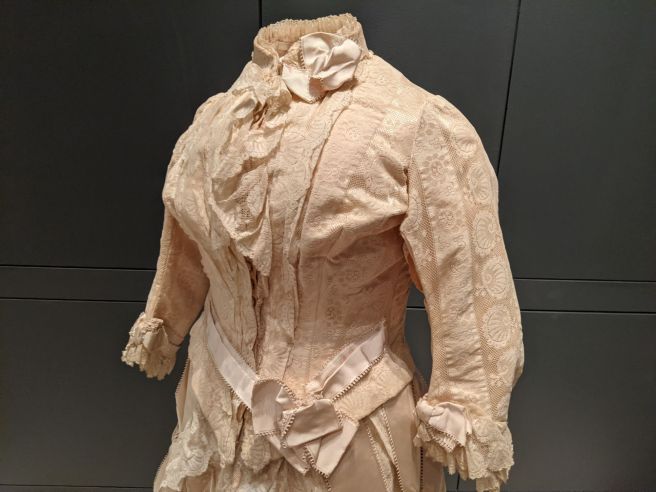
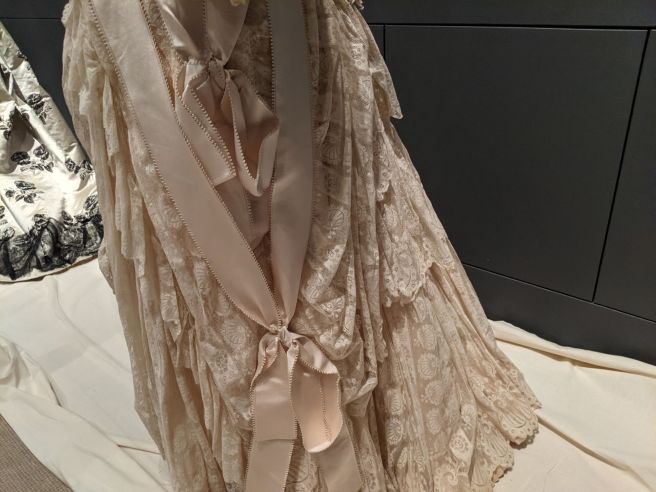
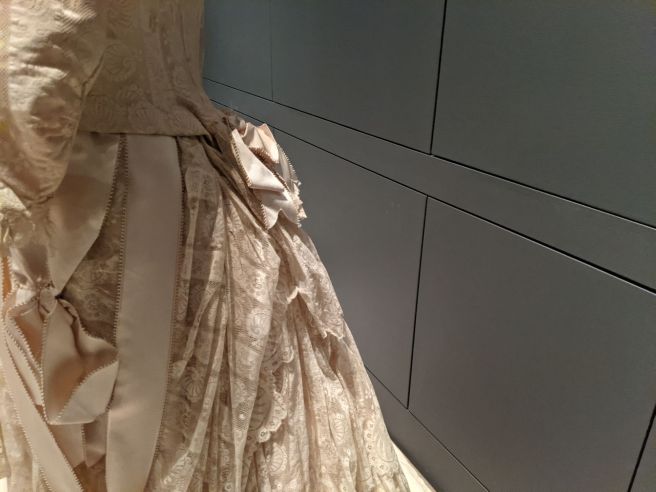
(I am APPALLED that I didn’t get a good photo of the lace-covered gown above, which was my favorite in the entire exhibition. How did that happen?)
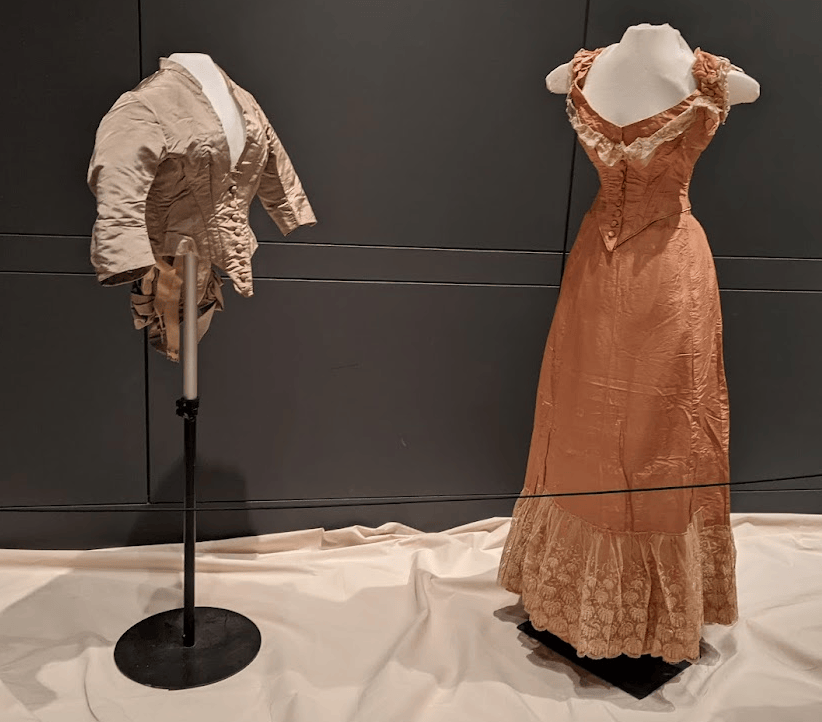
These two are both the work of Catherine Donovan. Very unassuming pieces from the 1870s, they were made in her early years at 8 E. 18th St., near Union Square.
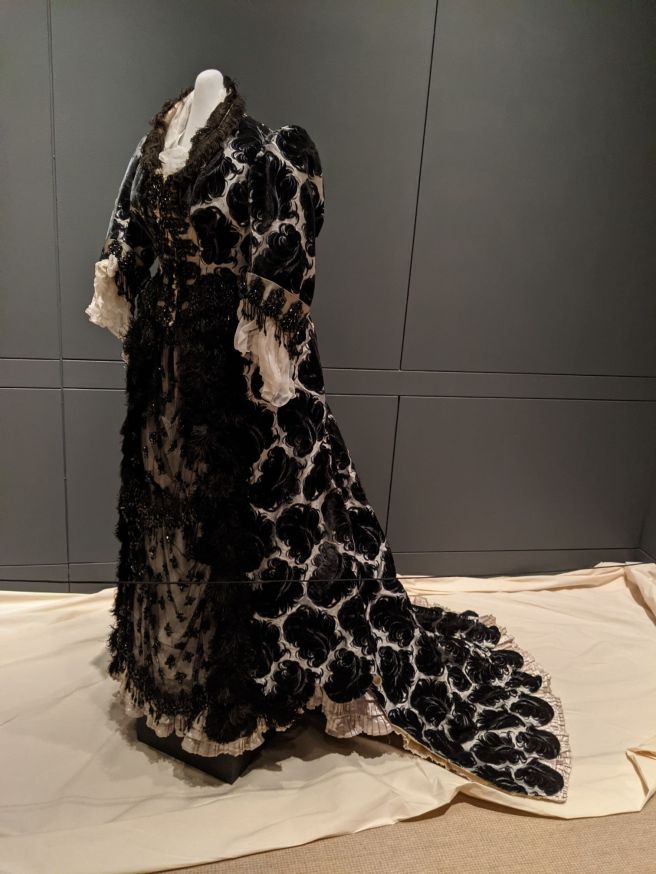
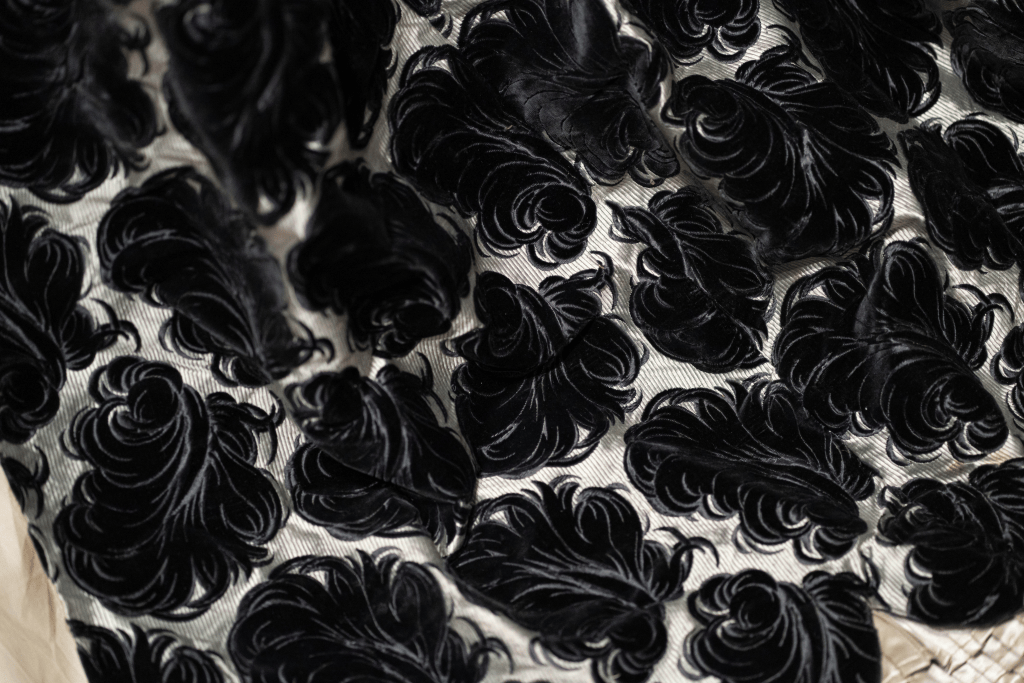
While this dinner gown represents her work in later decades, when she was prestigious enough to be referred to as “Mme Donovan” at her establishment on Madison Ave. at E. 40th St.where she sold imported Worths and Pingats to New York socialites. (In fact, in 1895 she was involved in a scandal for getting an associate to bring more valuable stock in as a trousseau in order to avoid paying import duties, and the whole shipment was auctioned off.)
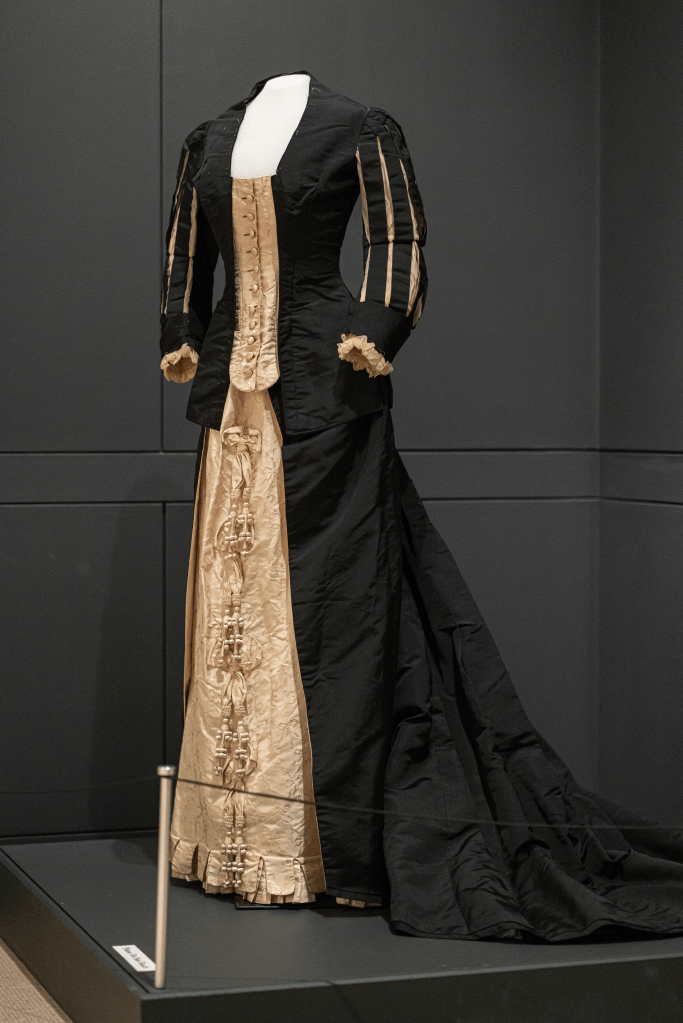
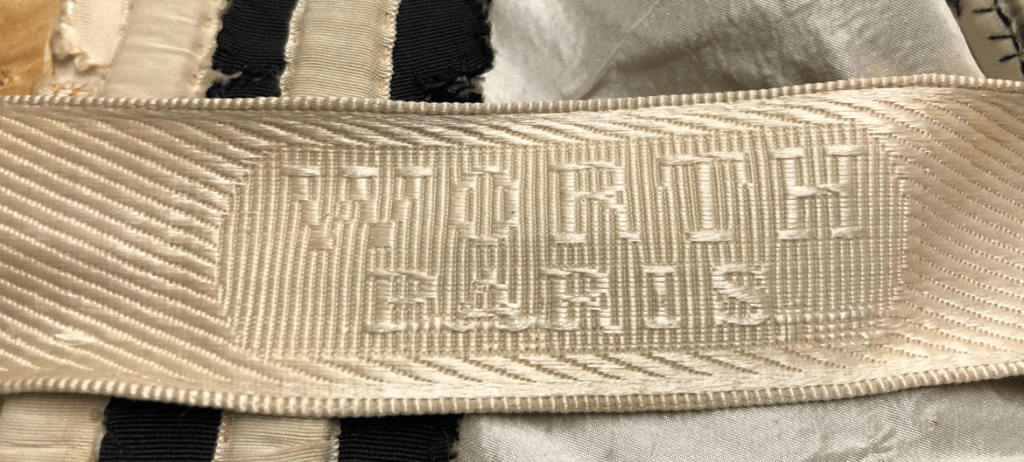
And speaking of Worth … While this exhibition was about fashionable dress made in New York State, many fashionable ladies were wearing Parisian gowns, and so the few of those in the collection also went out on display.
Frankly, this is not one of the best examples of a Worth that I’ve seen. It seems plausible to me that it’s a knock-off someone sewed a counterfeit Worth label into (it does not match any other Worth label from the period), or something along those lines; maybe it was just one of the semi-pre-made gowns that were fitted to traveling Americans for a lower price than the true couture creations. It does reflect Worth’s historicizing sensibilities, hearkening back to the early 17th century.
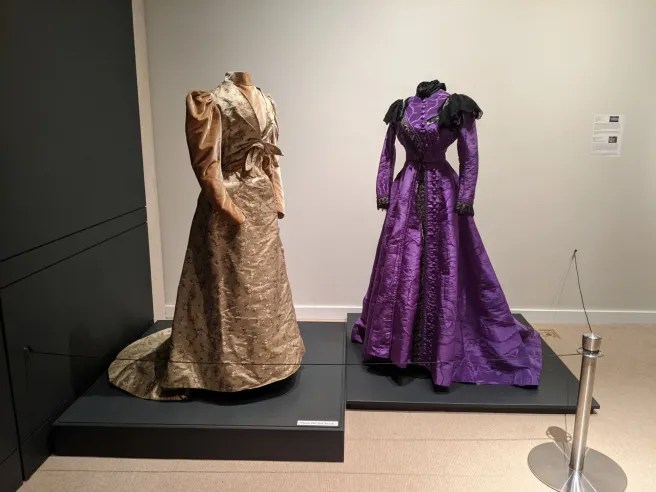
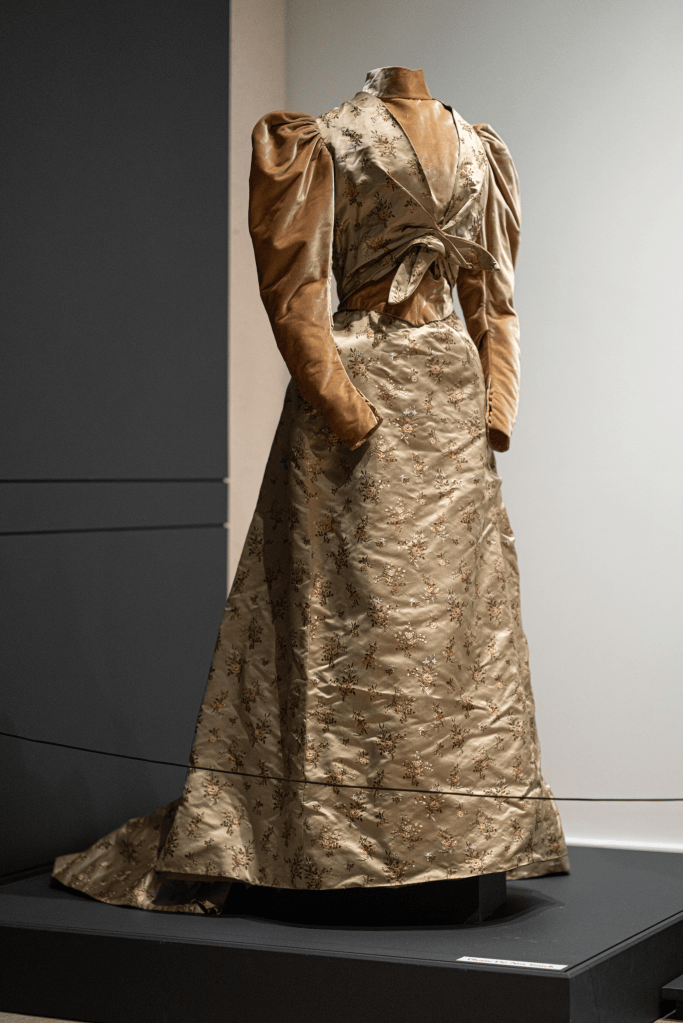
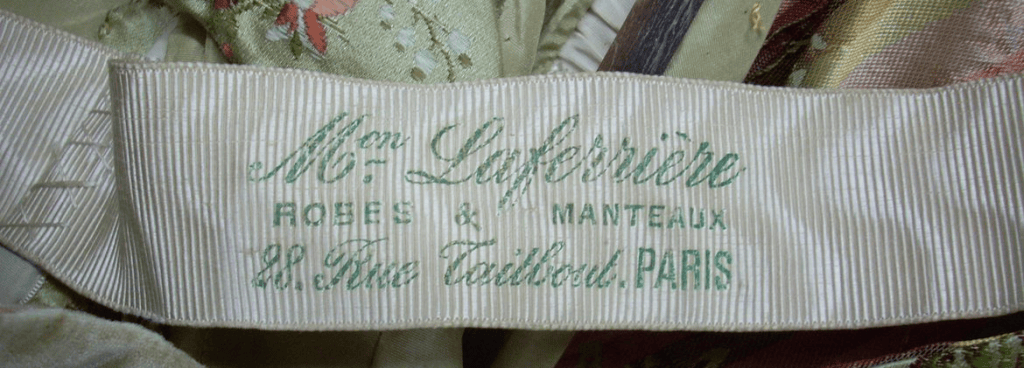
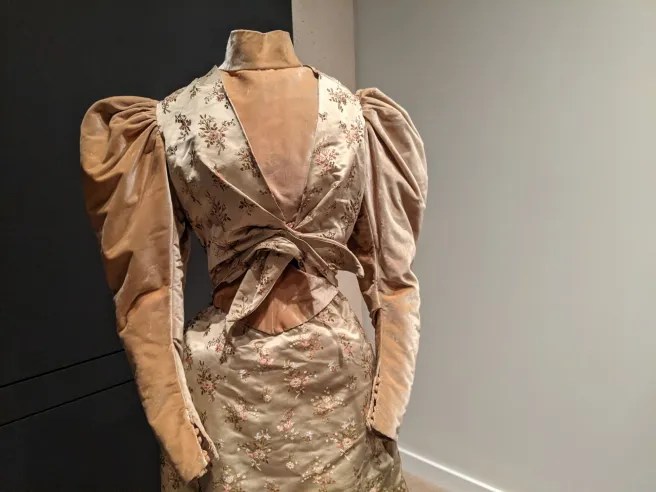
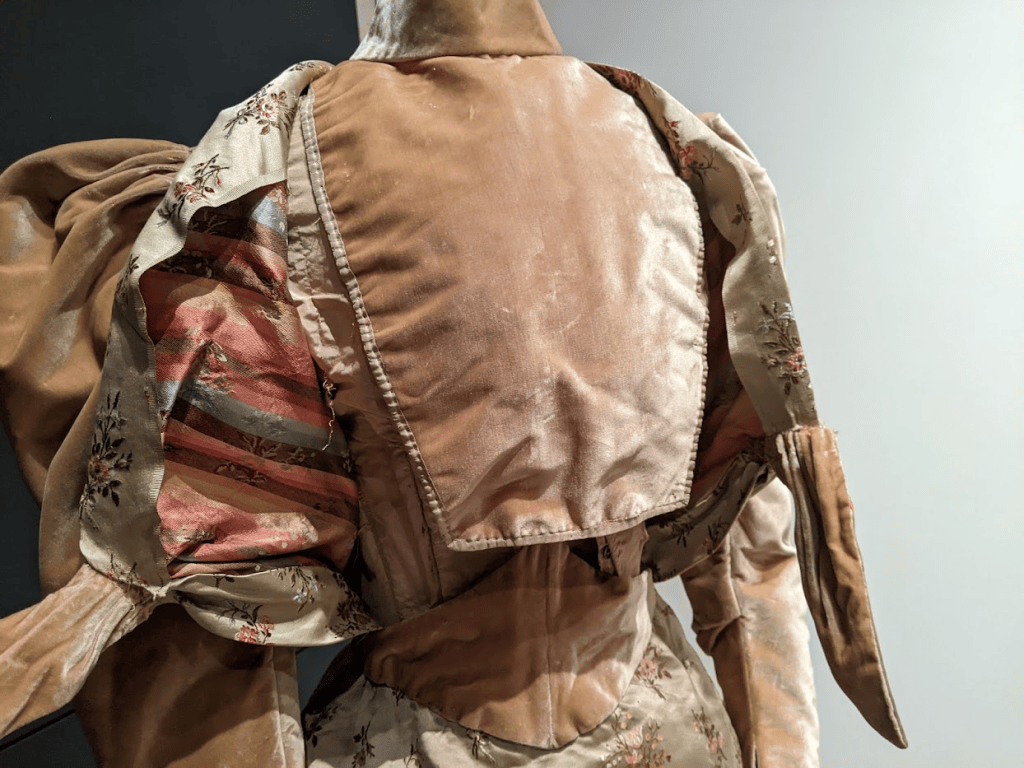
This ca. 1897 day dress came from Maison Laferrière, and I do believe it to be authentic given the overall quality and complexity. Madeleine Laferrière’s business opened in 1869 at 28 rue Taitbout, and it continued there even after her retirement around the turn of the century. Very little is known about her personally, but she catered to an elite clientele, including members of European royalty, such as Queen Maud of Norway and Queen Alexandra of Denmark.
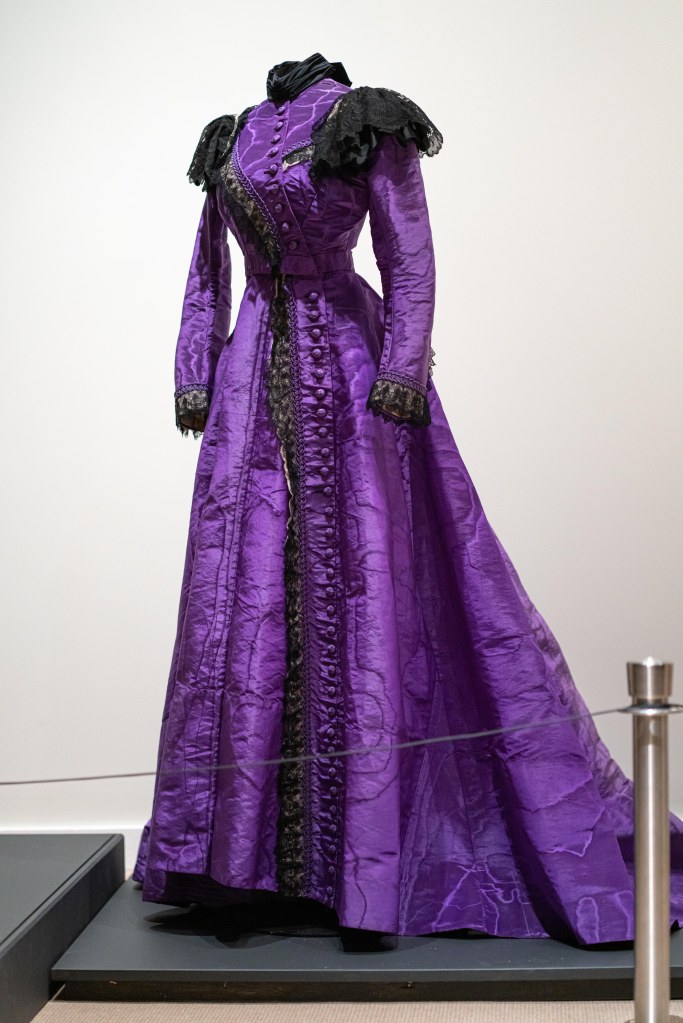
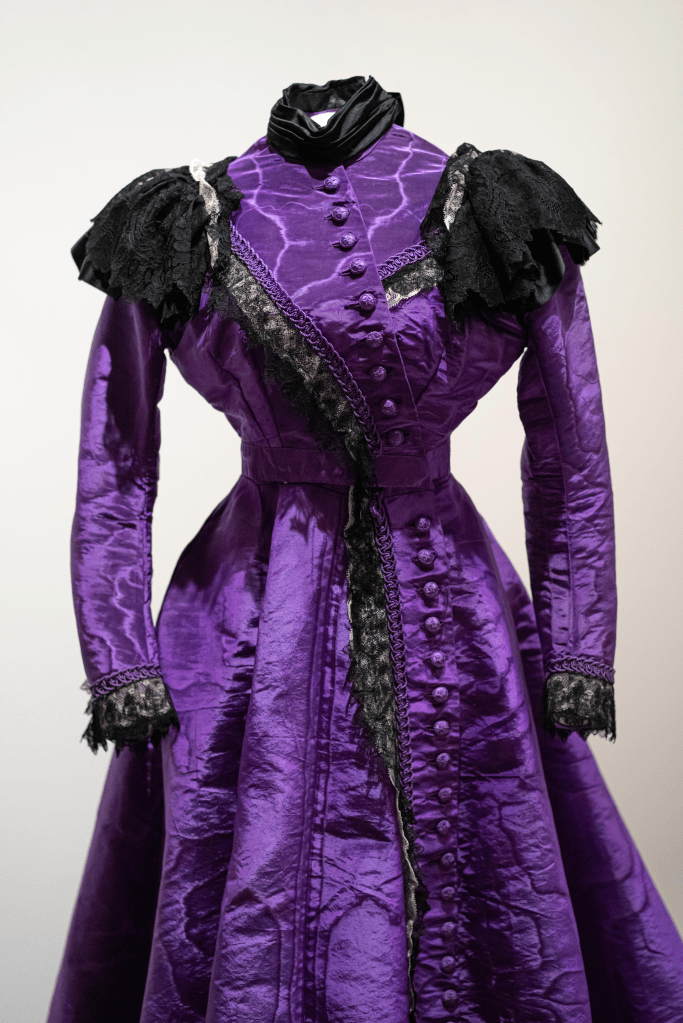
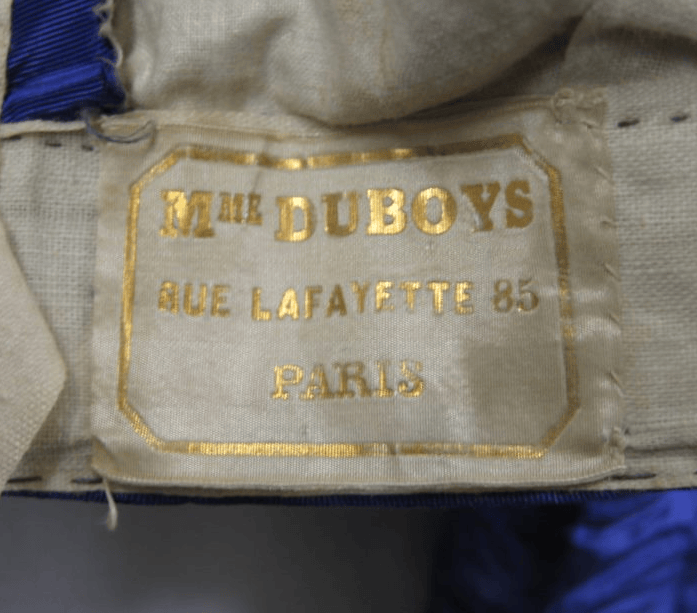
Mme Duboys, on the other hand, was Parisian but not ranked quite as highly as Worth or Laferrière. Her establishment (first in the rue d’Anjou, and eventually in the rue de Lafayette) did stand for more than two decades, however, and her gowns sold for hundreds of francs. She even carried on a mail-order business for those outside of Paris to acquire the latest fashions. One contemporary publication stated: “Everything that comes out of Madame Duboys’s shop has a particular cachet of good taste.”
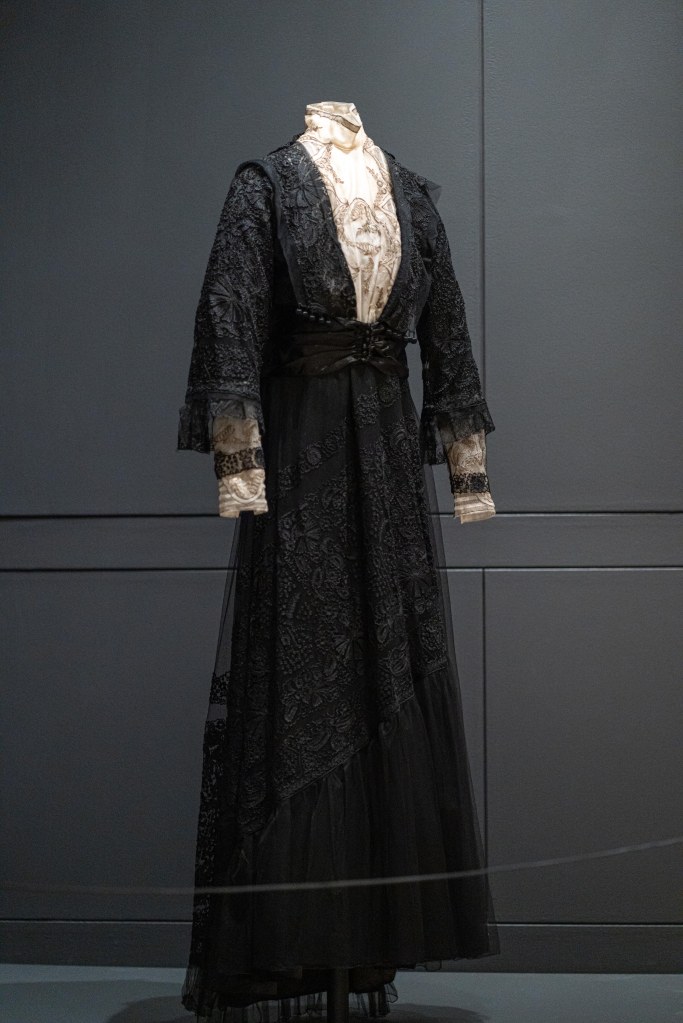
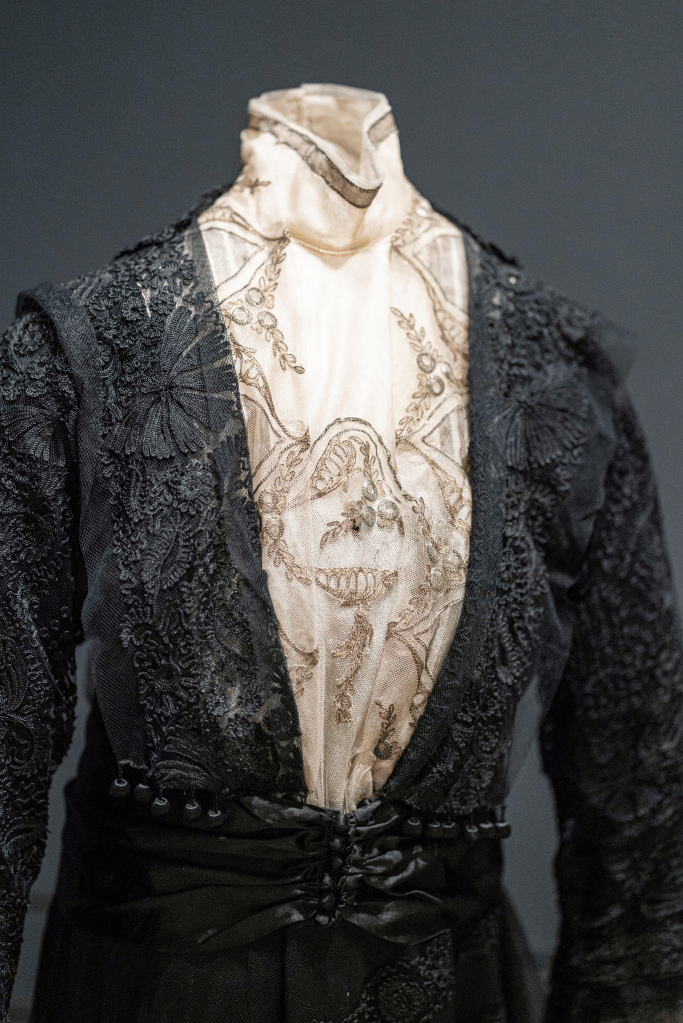
This was a late addition to the exhibition, as its “M. A. Robb” label was not mentioned in the database description and I only found it when searching individual garments. Mary A. Robb opened a dressmaking establishment at 27 E. 45th St. in New York City in 1900. Her shop moved to 3 E. 43rd by 1905. The address on the label in this gown is 22 E. 55th St, but there is no other record of her working out of that location. I’ve dated it to ca. 1909 due to the narrowness of the skirt, but the most fashionable were already moving their waistlines up by that time.
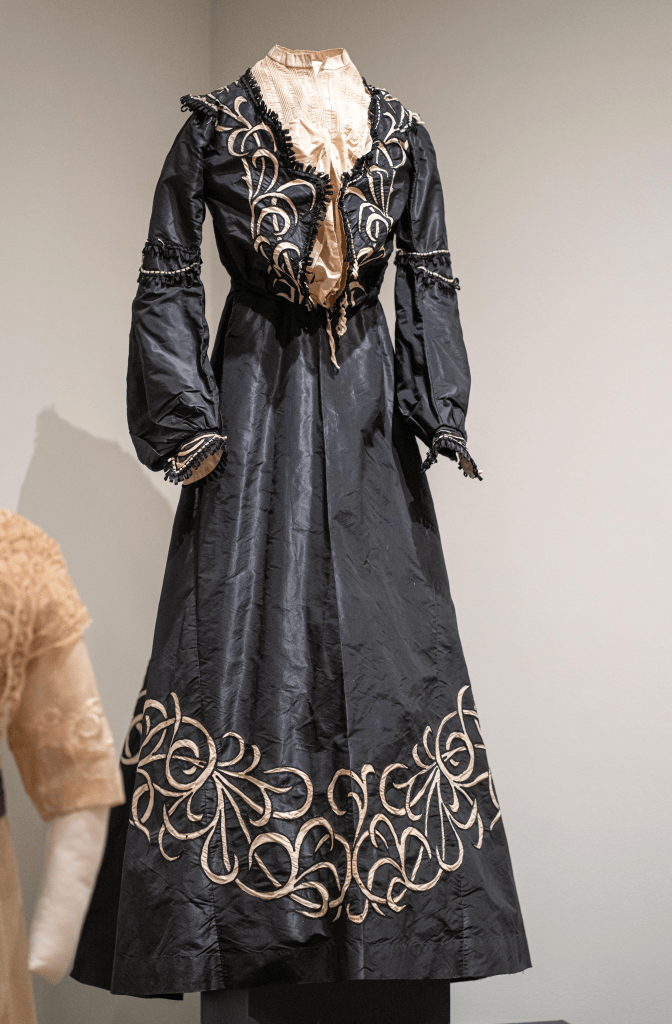
The swirls on this day dress strongly reflect the dominant Art Nouveau aesthetic, complementing the shape of the bodice and skirt. It was made by Marion or Mary Davey, who started her dressmaking business at 9 E. 41st St. in 1893. By 1896, she and a partner were trading as M. Davey & Co., and by 1904, she was no longer in business — this would have been from the last year or so of her tenure.
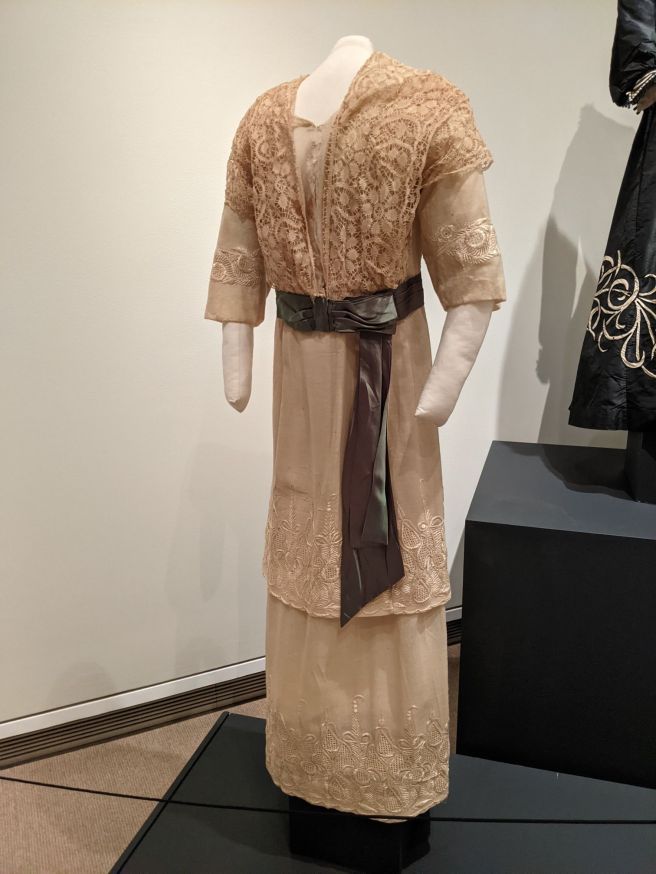
And finally, this somewhat odd fine wool or cashmere evening dress. My assumption is that it’s for winter wear, when it might have been chilly but short sleeves were still expected for formality.
Delia V. Walsh, it’s creator, ran a dressmaking business in Albany from about 1893 to 1935—an impressively long career. She first operated at 192 3rd St. in Arbor Hill and later moved a few blocks to 287 Clinton Ave., by the 1920s.


